


Abstract
This study reports on the uptake of 99mTc-RP527 by human breast carcinoma and its relationship to gastrin-releasing peptide receptor (GRP-R) expression as measured by immunohistochemistry (IHC). Methods: Nine patients referred because of a clinical diagnosis suggestive of breast carcinoma and 5 patients with tamoxifen-resistant bone-mestastasized breast carcinoma underwent 99mTc-RP527 scintigraphy. The findings were compared with routine staging examinations in all patients and with routine histology and IHC GRP-R staining in the first 9 patients. All 9 patients with suspected breast lesions were tumor positive. Results: The uptake of 99mTc-RP527 was evident in the primary tumor in 8 of 9 patients and in involved lymph nodes and part of the distant metastasis limited to the bone when present. 99mTc-RP527 uptake was not found in any of the tamoxifen-resistant patients. Conclusion: Uptake by primary breast carcinoma was significantly correlated with the presence of GRP-Rs as assessed by means of IHC.
Gastrin-releasing peptide/bombesin (GRP) has been shown to function as an autocrine growth factor in a variety of human tumors, including breast carcinoma (1). Its tumor growth–stimulating effect is a direct consequence of binding to the GRP G-protein–coupled receptor (GRP-R). With the aim of inhibiting breast tumor growth, this growth factor and its receptor have been evaluated as potential targets for various antagonists or blocking agents (2). As these blocking agents result in tumor stasis rather than regression, alternative techniques to morphologic imaging, assessing changes in tumor volume, will be necessary to monitor their efficacy.
The success of 111In-pentetreotide (111In-Octreoscan; COVIDIEN, USA) in demonstrating tumors with somatostatin receptors (3) and of 123I-vasoactive intestinal peptide (VIP) for visualization of tumors overexpressing VIP receptors by scintigraphic imaging (4) prompted the search for a radiolabeled GRP/bombesin analog. By virtue of their potential to visualize tumor lesion GRP-R status and its effective downregulation after efficient treatment, radiolabeled GRP analogs have the potential to predict or rapidly assess response to GRP-R–targeted treatment modalities.
99mTc-RP527 consists of a targeting peptide derived from bombesin, linked at its N-terminus via a linker group to a peptide sequence that chelates 99mTc. Unlabeled bombesin, uncomplexed RP527, and the structural mimic of 99mTc-RP527—RP720 (ReO-RP527)—inhibit binding of 125I-bombesin to GRP-R–expressing PC-3 and CF-PAC-1 cells (human prostate and pancreatic cancer cell lines, respectively) with similar mean 50% inhibitory concentration values ranging from 1.6 to 5.5 nM. Additionally, 99mTc-RP527 was rapidly and specifically bound and internalized by both PC-3 and CF-PAC-1 cells (5). The ligand has been shown to be safe and to exhibit good imaging characteristics (6,7). To our knowledge, data on the relationship between the uptake of 99mTc-RP527 by tumor tissue versus GRP-R status assessed by a gold standard have not been reported previously. This study examined the relationship between 99mTc-RP527 uptake in tumor lesions of patients with breast carcinoma and GRP-R expression as measured by immunohistochemistry (IHC).
MATERIALS AND METHODS
Patients
This study was approved by the Medical Ethics Committee of the University Hospital and performed according to Good Clinical Practice guidelines. Fourteen patients (mean age, 58.6 y; range, 37–75 y) were included in the study. All patients gave their written informed consent for participation in the study. Nine patients were referred because of a clinical diagnosis highly suggestive of breast carcinoma. These patients underwent 99mTc-RP527 scintigraphy on the day before biopsy or fine-needle biopsy or removal of the suspected mass. In addition to routine histopathologic analysis, slides of the primary lesion of these patients were stained for GRP-R. Another 5 patients with histologically proven and documented tamoxifen-resistant bone-metastasized breast carcinoma also underwent 99mTc-RP527 scintigraphy. In all 14 patients, routine staging examinations were performed within 1 wk after 99mTc-RP527 scintigraphy. Staging was performed according the TNM classification criteria.
Methods
Radiopharmaceutical Synthesis.
99mTc-RP527 labeling was performed using a kit formulation; 0.1 mL of 2 mM stannous chloride, 0.1 mL of 60 mM sodium gluconate, 1,850–2,035 MBq of 99mTcO4 in 0.3 mL of 0.9% sodium chloride, and 0.5 mL of 0.9% sodium chloride were added to 100 μg of RP527. After 35 min in a boiling water bath, the reaction mixture was allowed to cool down to room temperature and injected on a high-performance liquid chromatography system using an ethanol/water/acetic acid gradient. The radiolabeled peptide was collected at 45 min, and the collected eluent was diluted with 10 mL of 0.9% sodium chloride. The overall yield of the radiosynthesis was about 30%, with a radiochemical purity ≥ 90% and a specific activity ≥ 4.32 TBq/μmol.
Scintigraphy.
Subjects were positioned supine with their arms alongside their body. Whole-body images were performed using a triple-head γ-camera (Irix; Picker), equipped with low-energy, high-resolution, parallel-hole collimators. The energy peak was centered at 140 keV with a 15% window. Whole-body (scan speed, 11.3 cm/min) and tomographic scans were acquired 5–6 h after injection. Localized SPECT acquisitions made of known tumor regions with a 120 × 20 s acquisition over 360° were reconstructed iteratively (ordered-subset expectation maximization algorithm; 2 iterations, 6 subsets) and postfiltered using a Butterworth filter (cutoff frequency, 0.8 cycle/cm; order, 8). The ratios of tumor to normal tissue (T/N ratios) were determined on summed tomographic slices by placing a region of interest (ROI) over the hottest part of the tumor (T) and an identically sized ROI over contralateral normal breast tissue (N).
IHC.
IHC was performed on formalin-fixed paraffin-embedded samples of the primary tumor held by the Department of Pathology of the Ghent University Hospital. Sections (4-μm-thick) were mounted on SuperFrost microscope slides (Menzel-Glaser), which were deparaffinized in xylene and rehydrated in a downgraded series of ethanol. The GRP-R status of lymph nodes was not assessed as the nodes were not systematically available and also to avoid partial-volume–related discordances. After flushing in water, heat-induced antigen retrieval was performed for 20 min with a corresponding buffer (citrate buffer, pH 6.0), cooled down for 20 min, and then flushed in water for 10 min. Endogenous tissue peroxidase was blocked for 5 min with H2O2 (Dako). Slides were then incubated with a commercially available primary antihuman GRP-R antibody (Santa Cruz Biotechnology) diluted in 1% bovine serum albumin/Tris-buffered saline and incubated for 1 h; the dilution factor was 1:10. After washing, the sections were incubated for 30 min with a labeled polymer-horseradish peroxidase antirabbit secondary antibody (Dako). The chromogen 3,3′-diaminobenzidine (Dako) was used for spectrophotometric visualization of the signal as brown staining. After washing, the sections were counterstained with hematoxylin.
Microscopic Analysis.
The intensity and amount of GRP-R–positive tumor cells in the immunoreaction were determined independently by 2 pathologists who were unaware of the scintigraphic results. The percentage of tumor cells that were GRPR-R positive was scored as follows: 0%, score 0; 0%–20%, score 1; 20%–40%, score 2; 40%–60%, score 3; 60%–80%, score 4; and 80%–100%, score 5. Intensities of staining were classified from 0 (absent staining) to 4 (high staining). A score of 1, 2, or 3 corresponds to very low, low, and intermediate intensity of staining, respectively. For each tumor, a value designated as the H score was than obtained by multiplying the intensity score by the percentage score. This methodology was shown previously to be highly reproducible (intraclass correlation analysis for intra- and interobserver variability: r = 0.94 [P = 0.001] and r = 0.9 [P = 0.001], respectively) (8).
Routine immunohistochemical assessment of estrogen receptor (ER) and progesterone receptor (PR) status was performed using commercially available antibodies.
RESULTS
After injection of ∼555 MBq 99mTc-RP527 (maximum, 3 ng/kg per subject), no adverse or subjective effects were noted in any of the subjects. The whole-body and tomographic images obtained show a diffuse and heterogeneous uptake of radioactivity in the normal breast tissue, limited to the central, periaureolar glandular part of the breast. Imaging results of 6 of the patients included were reported previously (6).
Results of the 9 patients referred because of a clinical diagnosis highly suggestive of breast carcinoma are shown in Table 1. All 9 patients with suspected breast lesions were tumor positive on histology. Four of 9 patients were ER and PR positive and 2 of 9 patients were solely ER positive. Primary tumor 99mTc-RP527 uptake was clearly depicted in 8 of 9 patients. In these 8 patients, involved lymph nodes and part of the distant metastases limited to the bone (occurring in only 1 patient), when present, also showed 99mTc-RP527 uptake (Figs. 1 and 2). Tumor-to-background ratios of involved lymph nodes and bone metastases in these patients ranged from 2 to 20 (mean, 10.3). In 99mTc-RP527–positive patients, T/N ratios of the primary tumor derived from tomographic images ranged from 1 to 14 (mean, 6.3). GRP-R staining was positive in all 9 patients but to a variable degree: H scores ranged from 2 to 15 (mean, 8.4). Staining was cytoplasmatic as well as membranous and was more pronounced in the well-differentiated parts of the tumors. There was, however, no relationship between the global degree of differentiation and obtained H scores. Histologic H scores were significantly correlated with T/N ratios (Spearman rank; r = 0.929, P = 0.0001) (Fig. 3) (8).

(A and B) Faint GRP-R staining of breast carcinoma cells in patient 8 (A), indicated by small arrows, and lack of 99mTc-RP527 uptake in the same patient's breast tumor on transaxial slices (B). (C and D) Pronounced GRP-R staining of breast carcinoma cells in patient 1 (C), indicated by small arrows, and high uptake of 99mTc-RP527 uptake in the same patient's breast tumor on transaxial slices (D).
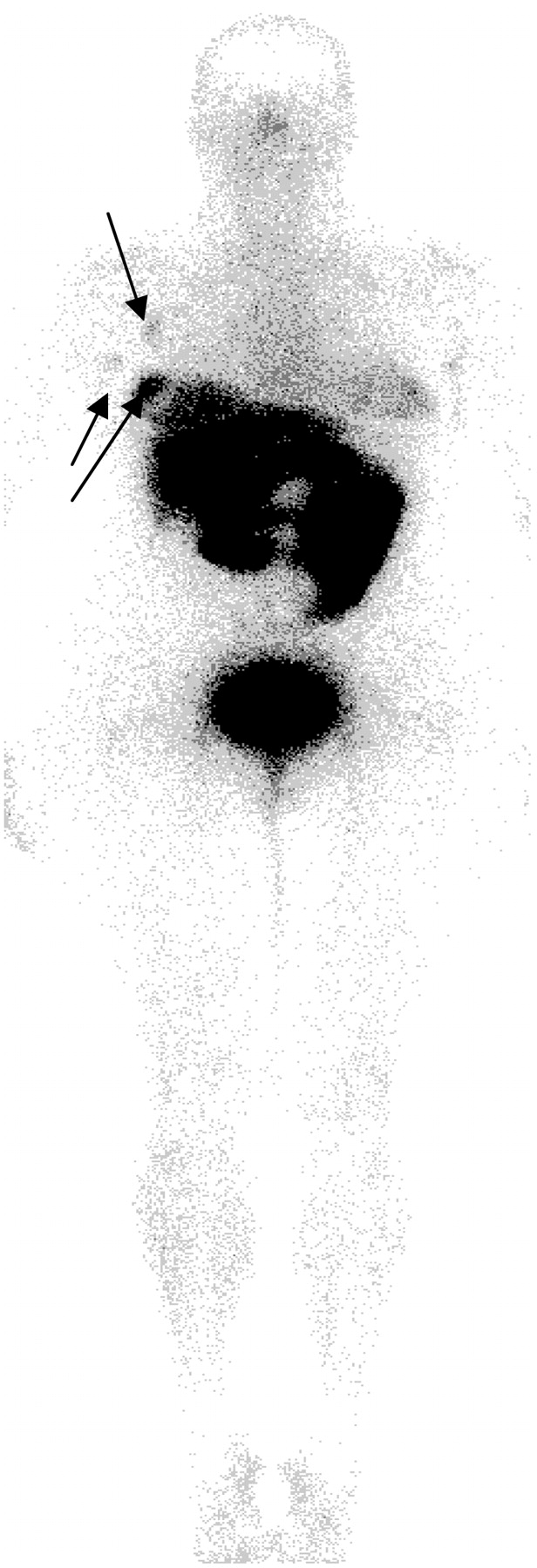
Anterior whole-body scan of patient 9 documenting 99mTc-RP527 uptake in primary breast tumor, involved axillary lymph nodes, and a rib metastasis (indicated by arrows).

Scatter plot shows relationship between 99mTc-RP527 tumor-to-background ratios and GRP-R H score.
Clinical, Pathologic, and Scintigraphic Findings in Patients Presenting with Primary Untreated Breast Carcinoma
Osseous involvement was not visualized by means of 99mTc-RP527 scintigraphy in any of the 5 bone-metastasized breast carcinoma patients.
DISCUSSION
Our data show 99mTc-RP527 uptake in untreated primary breast carcinoma and related metastases, but not in metastases of previously treated patients, as well as ubiquitous and heterogeneous 99mTc-RP527 uptake in nonneoplastic breast tissue.
Expression of GRP-R in primary human breast carcinoma has been studied previously by methodologies other than scintigraphy or IHC. Using receptor-binding techniques on tumor homogenates, Halmos et al. found that 33% (33/100) of primary breast carcinomas were GRP-R positive (9). On the other hand, using in vitro autoradiography, Gugger et al. reported a 62% (44/71) incidence of GRP-Rs in primary breast carcinomas (10). In the series presented, 8 of 9 (88%) primary breast carcinomas were GRP-R positive as measured by in vivo 99mTc-RP527 scintigraphy, and all primary tumors studied proved to be positive on IHC. It is important to note that semiquantitative histologic GRP-R scores were significantly correlated with T/N ratios. The different incidence numbers found between our series and those by Halmos et al. and Gugger et al. likely relate to differences in patient inclusion and methodology. Of interest, if the primary tumor was GRP-R positive as assessed by 99mTc-RP527 scintigraphy, involved lymph nodes were also positive and easily depictable, even if a single lymph node was involved. This finding is in agreement with the data by Gugger et al. showing a high GRP-R density and homogeneous distribution in axillary lymph-node metastases and the lack of GRP-Rs in surrounding lymphoreticular tissue (high tumor-to-background ratio) (10). Finally, in the 1 patient presenting with a primary breast carcinoma and osseous involvement, both primary but only half of the metastatic bone lesions took up 99mTc-RP527, probably reflecting the difference in clonal origin—with distinct biologic parameters—of metastatic lesions.
In the 5 patients with tamoxifen-resistant osseous disease, none of the known sites of osseous involvement were positive on 99mTc-RP527 scintigraphy. The absence of uptake in these less-differentiated tumors when compared with untreated primary tumors and the more-pronounced expression on well-differentiated areas of tumor as demonstrated by IHC in this study supports the notion that apart from its known mitogenic and growth-stimulating activivity (2), GRP-R could also act as a morphogen or differentiation factor in breast carcinoma. A role for GRP-R as a morphogen has been reported previously in other types of tumors (11).
Finally, Gugger et al. described a ubiquitous heterogeneous GRP-R expression in normal breast ductules and lobules, possibly related to a heterogenous innervation pattern of the glands and lobules, assuming that GRP plays a neurotransmitter role in the breast, as it does in the gastrointestinal tract (10). As the sample size containing nonneoplastic breast tissue was often small, the authors suggested that the percentage of receptor heterogeneity may not be representative for the whole breast. The 99mTc-RP527 images show that the heterogeneous GRP-R expression to be limited to the central, glandular part of the breast. The reason for this heterogeneity and the relative high incidence when compared with other hormone receptors—for example, ER and PR (Table 1)—warrants further investigation. Possibly GRP-R, similar to ER and PR, may be involved in the regulation of mammary cell proliferation and differentiation.
During the past 10 y, several cytotoxic peptide hormone analogs of GRP and bombesin, as well as β-emitter–radiolabeled bombesin derivatives, have been developed for the purpose of improving outcome in patients with GRP-R–expressing malignancies such as breast carcinoma (12,13). 99mTc-RP527 might allow for selection of those patients that will ultimately benefit from these novel treatment options. The advantages and disadvantages of 99mTc-RP527 SPECT versus PET with newly developed positron-emitter–radiolabeled bombesin derivatives warrant further exploration (14).
CONCLUSION
In this pilot study, 99mTc-RP527 imaging results obtained in breast carcinoma patients were significantly correlated with results obtained by means of IHC.
Footnotes
-
COPYRIGHT © 2008 by the Society of Nuclear Medicine, Inc.
References
- Received for publication September 10, 2007.
- Accepted for publication November 6, 2007.



Jump to section
Related Articles
Cited By...
- Head-to-Head Comparison of [68Ga]Ga-NOTA-RM26 and [18F]FDG PET/CT in Patients with Gastrointestinal Stromal Tumors: A Prospective Study
- Clinical Translation of a Dual Integrin {alpha}v{beta}3- and Gastrin-Releasing Peptide Receptor-Targeting PET Radiotracer, 68Ga-BBN-RGD
- 68Ga-NOTA-Aca-BBN(7-14) PET/CT in Healthy Volunteers and Glioma Patients
- In Vitro and In Vivo Application of Radiolabeled Gastrin-Releasing Peptide Receptor Ligands in Breast Cancer
- Targeting Neuropeptide Receptors for Cancer Imaging and Therapy: Perspectives with Bombesin, Neurotensin, and Neuropeptide-Y Receptors
- Bombesin Antagonist-Based Radioligands for Translational Nuclear Imaging of Gastrin-Releasing Peptide Receptor-Positive Tumors
- Radiopeptide Imaging and Therapy in Europe
- Evaluation of a 1,4,7,10-Tetraazacyclododecane-1,4,7,10-Tetraacetic Acid-Conjugated Bombesin-Based Radioantagonist for the Labeling with Single-Photon Emission Computed Tomography, Positron Emission Tomography, and Therapeutic Radionuclides
- Peptide-Based Probes for Cancer Imaging