JNM
HOME HELP FEEDBACK SUBSCRIPTIONS ARCHIVE SEARCH TABLE OF CONTENTS
 QUICK SEARCH:   [advanced]


The Journal of Nuclear Medicine Vol. 41 No. 2 234-241
© 2000 by Society of Nuclear Medicine
This Article
Right arrow Full Text (PDF)
Right arrow Alert me when this article is cited
Right arrow Alert me if a correction is posted
Services
Right arrow Email this article to a friend
Right arrow Similar articles in this journal
Right arrow Similar articles in PubMed
Right arrow Alert me to new issues of the journal
Right arrow Download to citation manager
Right arrow reprints & permissions
Citing Articles
Right arrow Citing Articles via HighWire
Right arrow Citing Articles via Google Scholar
Google Scholar
Right arrow Articles by van Dyck, C. H.
Right arrow Articles by Innis, R. B.
Right arrow Search for Related Content
PubMed
Right arrow PubMed Citation
Right arrow Articles by van Dyck, C. H.
Right arrow Articles by Innis, R. B.

PET Quantification of 5-HT2A Receptors in the Human Brain: A Constant Infusion Paradigm with [18F]Altanserin

Christopher H. van Dyck, Ping-Zhong Tan, Ronald M. Baldwin, Louis A. Amici, Pradeep K. Garg, Chin K. Ng, Robert Soufer, Dennis S. Charney and Robert B. Innis

Departments of Psychiatry and Diagnostic Radiology, Yale University School of Medicine, New Haven
West Haven Veterans' Affairs Medical Center, West Haven, Connecticut

Correspondence: For correspondence or reprints contact: Christopher H. van Dyck, MD, Yale University School of Medicine, CB 2041, 333 Cedar St., New Haven, CT 06510.

ABSTRACT

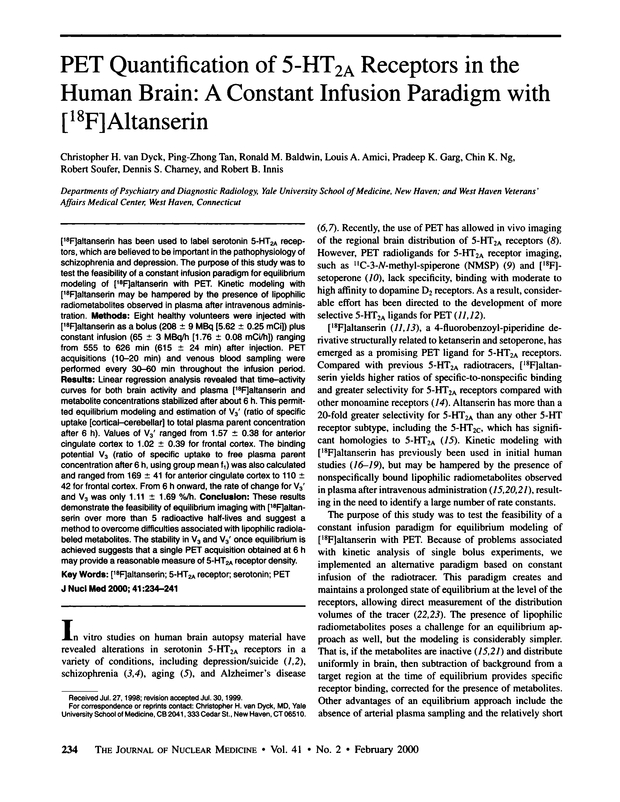
[18F]altanserin has been used to label serotonin 5-HT2A receptors, which are believed to be important in the pathophysiology of schizophrenia and depression. The purpose of this study was to test the feasibility of a constant infusion paradigm for equilibrium modeling of [18F]altanserin with PET. Kinetic modeling with [18F]altanserin may be hampered by the presence of lipophilic radiometabolites observed in plasma after intravenous administration. Methods: Eight healthy volunteers were injected with [18F]altanserin as a bolus (208 ± 9 MBq [5.62 ± 0.25 mCi]) plus constant infusion (65 ± 3 MBq/h [1.76 ± 0.08 mCi/h]) ranging from 555 to 626 min (615 ± 24 min) after injection. PET acquisitions (10–20 min) and venous blood sampling were performed every 30–60 min throughout the infusion period. Results: Linear regression analysis revealed that time-activity curves for both brain activity and plasma [18F]altanserin and metabolite concentrations stabilized after about 6 h. This permitted equilibrium modeling and estimation of V3' (ratio of specific uptake [cortical-cerebellar] to total plasma parent concentration after 6 h). Values of V3' ranged from 1.57 ± 0.38 for anterior cingulate cortex to 1.02 ± 0.39 for frontal cortex. The binding potential V3 (ratio of specific uptake to free plasma parent concentration after 6 h, using group mean f1) was also calculated and ranged from 169 ± 41 for anterior cingulate cortex to 110 ± 42 for frontal cortex. From 6 h onward, the rate of change for V3' and V3 was only 1.11 ± 1.69 %/h. Conclusion: These results demonstrate the feasibility of equilibrium imaging with [18F]altan-serin over more than 5 radioactive half-lives and suggest a method to overcome difficulties associated with lipophilic radiola-beled metabolites. The stability in V3 and V3' once equilibrium is achieved suggests that a single PET acquisition obtained at 6 h may provide a reasonable measure of 5-HT2A receptor density.

Key Words: [18F]altanserin • 5-HT2A receptor • serotonin • PET


This article has been cited by other articles:


Home page
JNMHome page
J. K. Staley, C. H. van Dyck, D. Weinzimmer, E. Brenner, R. M. Baldwin, G. D. Tamagnan, P. Riccardi, E. Mitsis, and J. P. Seibyl
123I-5-IA-85380 SPECT Measurement of Nicotinic Acetylcholine Receptors in Human Brain by the Constant Infusion Paradigm: Feasibility and Reproducibility
J. Nucl. Med., September 1, 2005; 46(9): 1466 - 1472.
[Abstract] [Full Text] [PDF]


HOME HELP FEEDBACK SUBSCRIPTIONS ARCHIVE SEARCH TABLE OF CONTENTS
JOURNAL OF NUCLEAR MEDICINE TECHNOLOGY THE JOURNAL OF NUCLEAR MEDICINE
Copyright © 2000 by the Society of Nuclear Medicine.