


Abstract
The diagnosis of pulmonary embolism (PE) is usually established by a combination of clinical assessment, D-dimer testing, and imaging with either pulmonary ventilation–perfusion (V/Q) scintigraphy or pulmonary multidetector CT (MDCT) angiography. Both V/Q SPECT and MDCT angiography seem to have high diagnostic accuracy. However, only limited data directly comparing these 2 modalities are available. Hybrid γ-camera/MDCT systems have been introduced and allow simultaneous 3-dimensional lung V/Q SPECT and MDCT angiography, suitable for diagnosing PE. The aim of our study was to compare, in a prospective design, the diagnostic ability of V/Q SPECT, V/Q SPECT combined with low-dose CT, and pulmonary MDCT angiography obtained simultaneously using a combined SPECT/MDCT scanner in patients suspected of having PE. Methods: Consecutive patients from June 2006 to February 2008 suspected of having acute PE were referred to the Department of Nuclear Medicine at Rigshospitalet or Frederiksberg Hospital, Denmark, for V/Q SPECT as a first-line imaging procedure. The number of eligible patients was 196. Patients with positive D-dimer results (>0.5 mmol/mL) or a clinical assessment with a Wells score greater than 2 were included and underwent V/Q SPECT, low-dose CT, and pulmonary MDCT angiography in a single session. Patient follow-up was 6 mo. Results: A total of 81 simultaneous studies were available for analysis, of which 38% were from patients with PE. V/Q SPECT had a sensitivity of 97% and a specificity of 88%. When low-dose CT was added, the sensitivity was still 97% and the specificity increased to 100%. Perfusion SPECT with low-dose CT had a sensitivity of 93% and a specificity of 51%. MDCT angiography alone had a sensitivity of 68% and a specificity of 100%. Conclusion: We conclude that V/Q SPECT in combination with low-dose CT without contrast enhancement has an excellent diagnostic performance and should therefore probably be considered first-line imaging in the work-up of PE in most cases.
Acute pulmonary embolism (PE) is a severe and potentially fatal disease, with a mortality rate of approximately 30% if untreated. The incidence is 2 per 1,000 persons per year in Western countries (1–4).
PE is usually diagnosed through a combination of clinical assessment, blood sampling with D-dimer testing, and imaging with either pulmonary ventilation–perfusion (V/Q) scintigraphy or pulmonary multidetector CT (MDCT) angiography.
Pulmonary CT angiography has been shown to have a higher diagnostic accuracy and specificity than conventional planar V/Q scintigraphy (5,6). Thus, in many institutions, MDCT is first-line imaging in the daily clinical routine for patients suspected of PE (7–9). In addition, MDCT is fast, can yield an alternative diagnosis, and has a high degree of interobserver agreement (6,7,10,11).
Accordingly, in recent years the role of V/Q scintigraphy in the diagnosis of PE has diminished. Among the weaknesses of V/Q scintigraphy, if performed as traditional planar scintigraphy using Prospective Investigation of Pulmonary Embolism Diagnosis (PIOPED) interpretation criteria (12), are high proportions of equivocal studies (9,12) as well as moderate interobserver agreement (6). Yet, the introduction of 3-dimensional V/Q SPECT technology instead of 2-dimensional planar V/Q scintigraphy has in pilot data suggested high diagnostic accuracy for SPECT (13–15).
Both V/Q SPECT and MDCT angiography appear to have high diagnostic accuracy. However, very limited data directly comparing these two 3-dimensional modalities are available. The only head-to-head comparison currently available found that MDCT was superior in specificity but that V/Q SPECT was superior in sensitivity. However, the study was retrospective, used a 4-slice CT scanner, and allowed up to 3 d between MDCT and V/Q SPECT scanning (14).
Recently, hybrid γ-camera/MDCT systems have been introduced. These allow for simultaneous lung V/Q SPECT and MDCT angiography, which may be used for diagnosing PE (15,16). Comparison of simultaneous V/Q SPECT and pulmonary MDCT angiography for the detection of PE has, to our knowledge, never been undertaken.
Therefore, the aim of our study was to assess in a prospective design the diagnostic ability of V/Q SPECT compared with that of pulmonary MDCT angiography performed simultaneously using a dedicated combined SPECT/MDCT scanner in patients suspected of having PE. To do so, we investigated the accuracy of V/Q SPECT and pulmonary MDCT angiography and of combined V/Q SPECT and low-dose pulmonary CT without contrast agent administration.
MATERIALS AND METHODS
Study Design, Selection Criteria, and Patients
The study included consecutive patients suspected of acute PE at Rigshospitalet (third-line referral hospital) or Frederiksberg Hospital (primary referral hospital), Copenhagen, Denmark, from June 2006 to February 2008. All patients were referred to the Department of Nuclear Medicine at Rigshospitalet or Frederiksberg Hospital, Denmark, for V/Q SPECT as a first-line imaging procedure. The Local Scientific Ethics committee approved the study (H-KF-308395). Written informed consent was obtained from all patients. The study protocol complied with the guidelines of the Helsinki Declaration on human experimentation. Patients were eligible if there was suspicion of PE, defined as an acute onset of new—or a worsening of—shortness of breath or chest pain without any obvious cause, combined with positive D-dimer results (>0.5 mmol/mL) or a clinical assessment with a Wells score (17) greater than 2.
Among 196 consecutive patients referred to our departments, 96 patients (51 men) were excluded from the study because of contraindications to CT: an allergy to iodine contrast agents (2 patients); impaired renal function, defined as a P-creatinine level greater than 0.120 mmol/L (46 patients); and women under the age of 40 y (14 patients). Patients were also excluded from the study if they decided not to participate (6 patients), were not able to cooperate (11 patients), or could not have a peripheral venous access established (3 patients) or if there were hardware or software issues (8 patients). Three additional patients were excluded for other reasons, and 3 patients were ineligible to participate because of low clinical suspicion due to a Wells score of less than 2 and a negative D-dimer result.
All patients consented to diagnostic testing, including pulmonary MDCT angiography, low-dose CT without contrast enhancement, V/Q SPECT, blood pressure measurement, and blood sampling.
All patients had at least 6 mo of follow-up after the scans, with telephone interviews and review of hospital files.
Pulmonary MDCT angiography, low-dose CT, and V/Q SPECT were performed in the same session using a Precedence scanner (Philips), which is an integrated 2-head γ-camera combined with an MDCT scanner (16-slice Brilliance).
CT Acquisition Parameters and Image Reconstruction
The CT protocol consisted of 2 successive acquisitions with the patients scanned supine. The patients were allowed to breathe freely between the 2 scans. The first acquisition was a low-dose CT scan (140 kV, 20 mAs/slice, 16 × 1.5 collimator, 0.5-s rotation time, and pitch of 0.813) that was used for attenuation correction of V/Q SPECT data and obtained during tidal breathing.
The second acquisition was pulmonary MDCT angiography during a deep-inspiration breath-hold (120 kV, 230 mAs/slice, 16 × 0.75 mm collimator, 0.5-s rotation time, and pitch of 0.94). The images were acquired in the cephalocaudal direction and in a 512 × 512 matrix.
Biphasic administration of contrast medium (350 mg of iodine/mL, Optiray; Tyco Healthcare/Mallinckrodt) was performed with an automatic injection pump (Optivantage; Tyco Healthcare/Mallinckrodt). The first phase consisted of administration of 80 mL at 4.3 mL/s into a cubital vein followed by a saline chaser bolus of 45 mL injected at a flow rate of 4.3 mL/s.
To ensure optimal opacification of the lung arteries, we obtained the scan using bolus tracking, entering a circular region of interest in the trunk of the pulmonary artery. The threshold for triggering was preset at 100 Hounsfield units.
The pulmonary MDCT angiographic scans were reconstructed with a contiguous slice thickness of 0.8 mm and were reviewed on a dedicated workstation (Extended Brilliance Workspace, version 3.0; Philips).
All angiographic scans were evaluated by 2 readers (with 15 and 8 y of experience in evaluating pulmonary MDCT angiography) who were unaware of the clinical history. The diagnosis of PE was based on failure to enhance the entire lumen because of a filling defect (18).
Pulmonary V/Q SPECT Acquisition and Data Reconstruction
Pulmonary SPECT included a perfusion SPECT study and ventilation SPECT study obtained simultaneously within 13 min (i.e., 36 projections of 20 s each per head over 180°) immediately after the MDCT acquisition with the patient supine. Perfusion studies were performed after intravenous injection of 150 MBq of 99mTc-macroaggregated albumin (Mallinckrodt) during 2 respiratory cycles. Ventilation scintigraphy was conducted during quiet tidal inhalation of 81mKr made at our institution, which was extracted from a 600-MBq 81Rb–81mKr generator by oxygen flow of 1 L·min−1. Both studies were performed simultaneously with low-energy general-purpose collimators and acquired in a 128 × 128 matrix.
SPECT datasets were corrected for attenuation using the low-dose CT acquisition (without contrast medium) with iterative reconstruction using the software Autospect+ and Astonish with 3 iterations and 16 subsets (Philips).
The V/Q SPECT images were interpreted on a Jetstream workstation (Philips) by 2 readers (with 15 and 2 y of experience) who were unaware of the clinical history of the patients. The size and segmental location of all perfusion and ventilation defects were noted. PE was diagnosed if one or more mismatched perfusion defects with normal ventilation were present. V/Q SPECT datasets were first reviewed independently, and a diagnosis was established. Then, they were viewed in combination and fused with the pulmonary low-dose CT, and a new diagnosis was obtained. In a new reading, the perfusion SPECT was reviewed in combination with the low-dose CT, and a new diagnosis was established. We used an automatically 3-dimensional imaging registration software tool that displayed the low-dose CT, V/Q SPECT, and fusion images in axial, coronal, and sagittal planes (Syntegra, version 2.3.1; Philips).
The final diagnosis was made at a side-by-side consensus reading of all lesions detected on pulmonary MDCT angiography and V/Q SPECT using all available information: electrocardiography, transthoracic echocardiography, Doppler sonography of the lower-extremity veins, D-dimer levels, clinical data, and follow-up from hospital files or telephone interviews. PE was ruled out if patients had no evidence of PE in the clinical data or follow-up (including clinical time course), if they responded to treatment within 6 mo, or if they died and PE was an unlikely cause of death.
We did not usually repeat the V/Q SPECT or MDCT angiography, unless requested by the clinicians.
Statistical Analysis
Diagnostic performance was calculated as sensitivity, specificity, positive predictive value, negative predictive value, and accuracy. Ninety-five percent confidence intervals (19) were calculated. Patient characteristics were compared between the no-PE and PE groups using a 2-sample t test. D-dimer was log10-transformed to obtain a gaussian distribution. P values of less than 0.05 were considered significant. All statistical analyses were performed using SPSS software (version 15.0; SPSS Inc.) for Windows (Microsoft).
RESULTS
During the 18-mo recruiting period, 196 patients were screened and 100 were eligible for the study. Of the 100 patients eligible for the study, 6 were excluded because of poor contrast enhancement in the pulmonary vessels, and 8 were excluded because poor technical quality rendered the V/Q SPECT images uninterpretable.
For 5 patients, no final diagnosis could be determined (i.e., no reference was available), leaving a total of 81 patients available for analysis of the diagnostic performance of the imaging modalities. For V/Q SPECT alone, 4 of the 81 cases were inconclusive, leading to a nondiagnostic rate of 5%. For perfusion SPECT with low-dose CT, we found a nondiagnostic rate of 17%. In all other cases, both the pulmonary MDCT angiography and the V/Q SPECT in combination with low-dose CT could be interpreted as positive or negative, that is, a diagnostic rate of 100%. Patient characteristics are shown in Table 1.
Patient Characteristics
V/Q SPECT alone had a sensitivity of 97% and a specificity of 88%. When low-dose CT was added, the sensitivity was still 97% and the specificity increased to 100%. MDCT angiography alone had a sensitivity of 68% and a specificity of 100%. Perfusion SPECT with low-dose CT had a sensitivity of 93% and a specificity of 51%.
Further details on diagnostic performance are given in Tables 2 and 3.
2 × 2 Tables of the Imaging Modalities
Diagnostic Performance of the Imaging Modalities
The supplemental table lists patients with discrepancies (supplemental materials are available online only at http://jnm.snmjournals.org). In 10 patients with a PE diagnosis established at the consensus reading, PE could not be visualized on MDCT angiography. In 4 of these patients, PE could be localized when the pulmonary MDCT angiography datasets were combined with the V/Q SPECT. In all 4 patients, embolic thrombi were visualized in the same regions as the mismatched defects seen on V/Q SPECT; in 2 of these patients, the emboli were located in small subsegmental arteries. One patient with myelomatosis and a D-dimer of 8.7 had a negative PE diagnosis on V/Q SPECT, and MDCT angiography demonstrated a relatively large embolus in the left upper lobe at arterial level 2. Ultrasonography confirmed DVT of the lower-extremity vein. In the remaining 5 patients with PE on V/Q SPECT combined with low-dose CT, the pulmonary MDCT angiography acquisitions were technically perfect, with opacification of the pulmonary arteries at arterial levels 5–6.
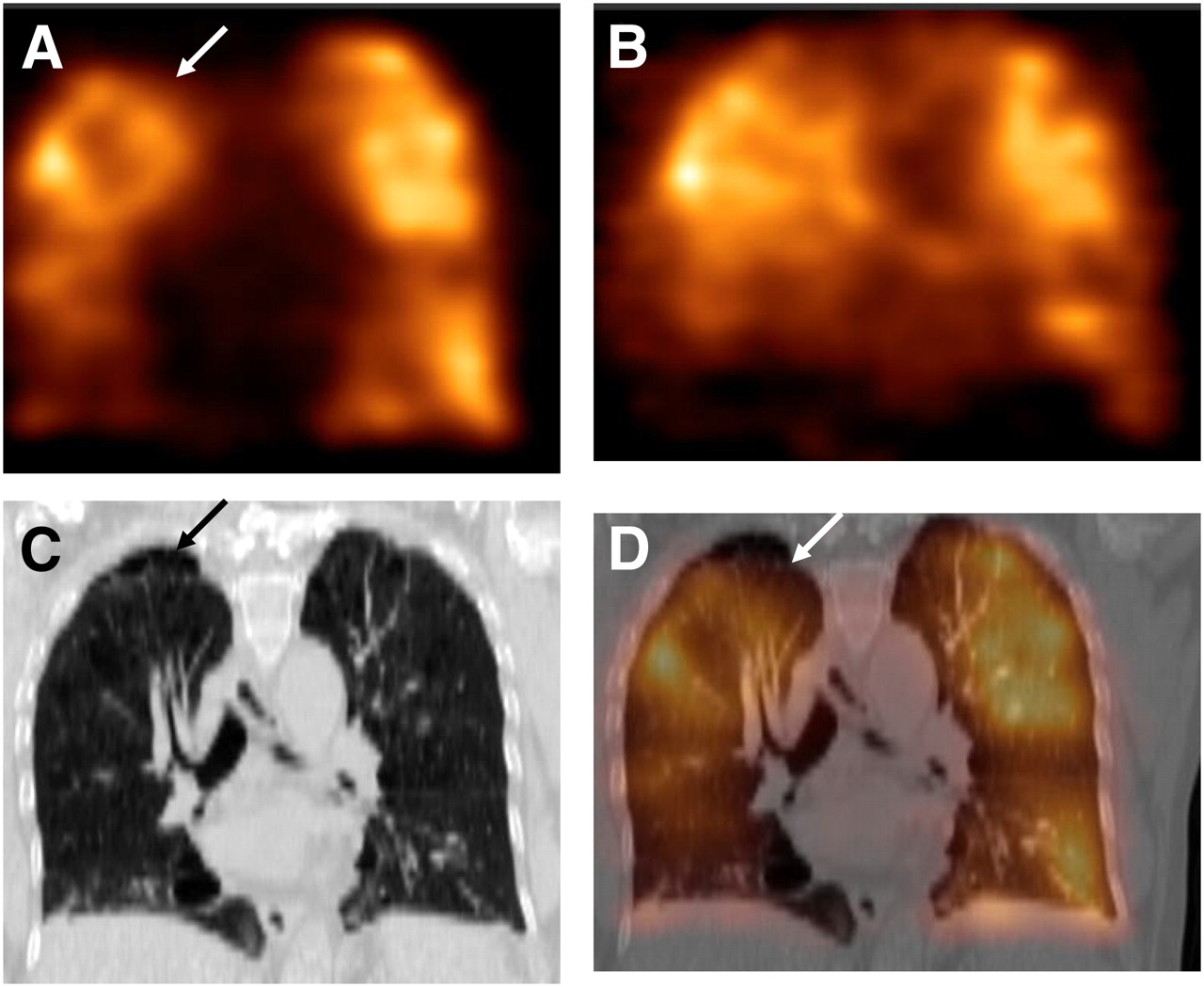
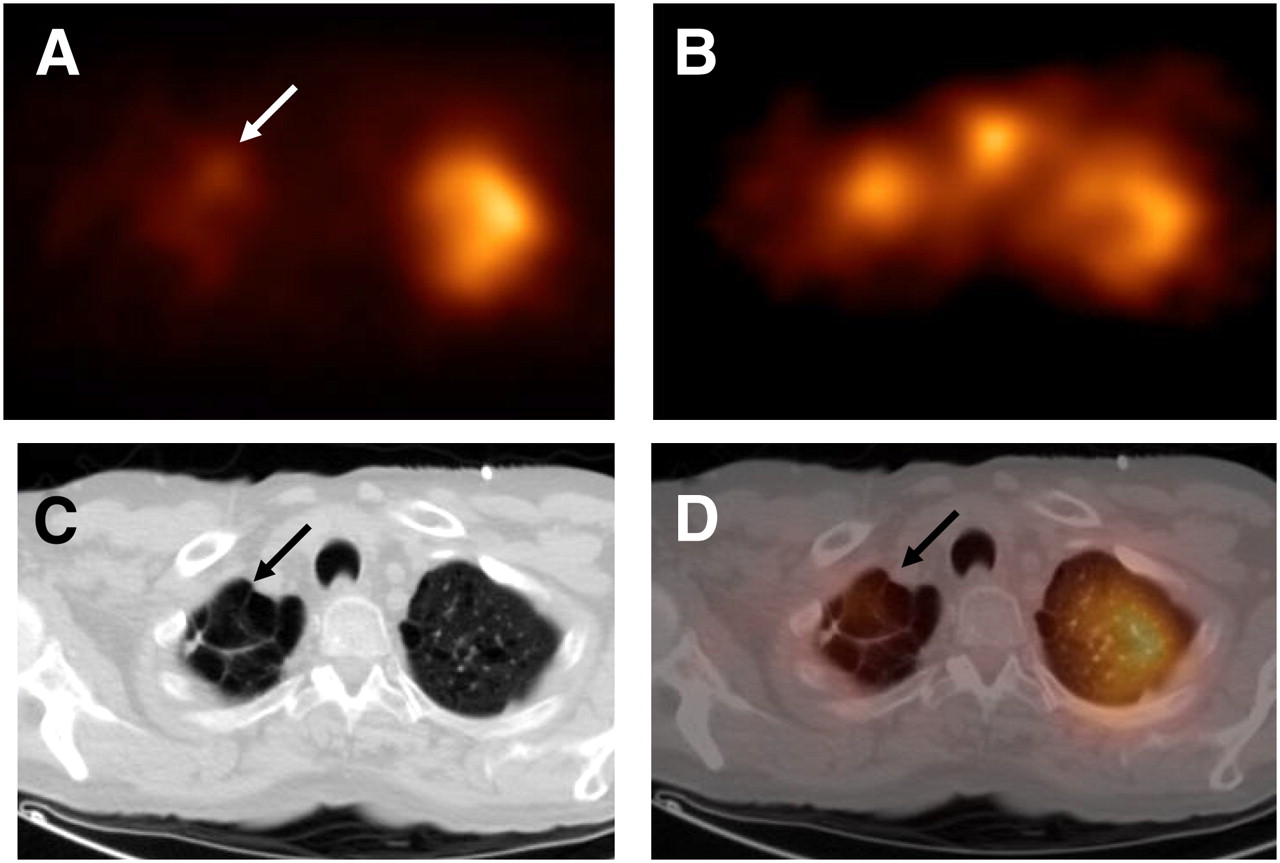
When the V/Q SPECT datasets alone were assessed, 6 patients had a false-positive diagnosis of PE: 3 patients had mismatched defects on the V/Q SPECT scans because of interlobar fissures, and 3 patients had chronic obstructive pulmonary disease and had mismatched defects because of paraseptal emphysema, pneumonic infiltration, atelectasis, and pleural fluid as seen on low-dose CT (Figs. 1 and 2).
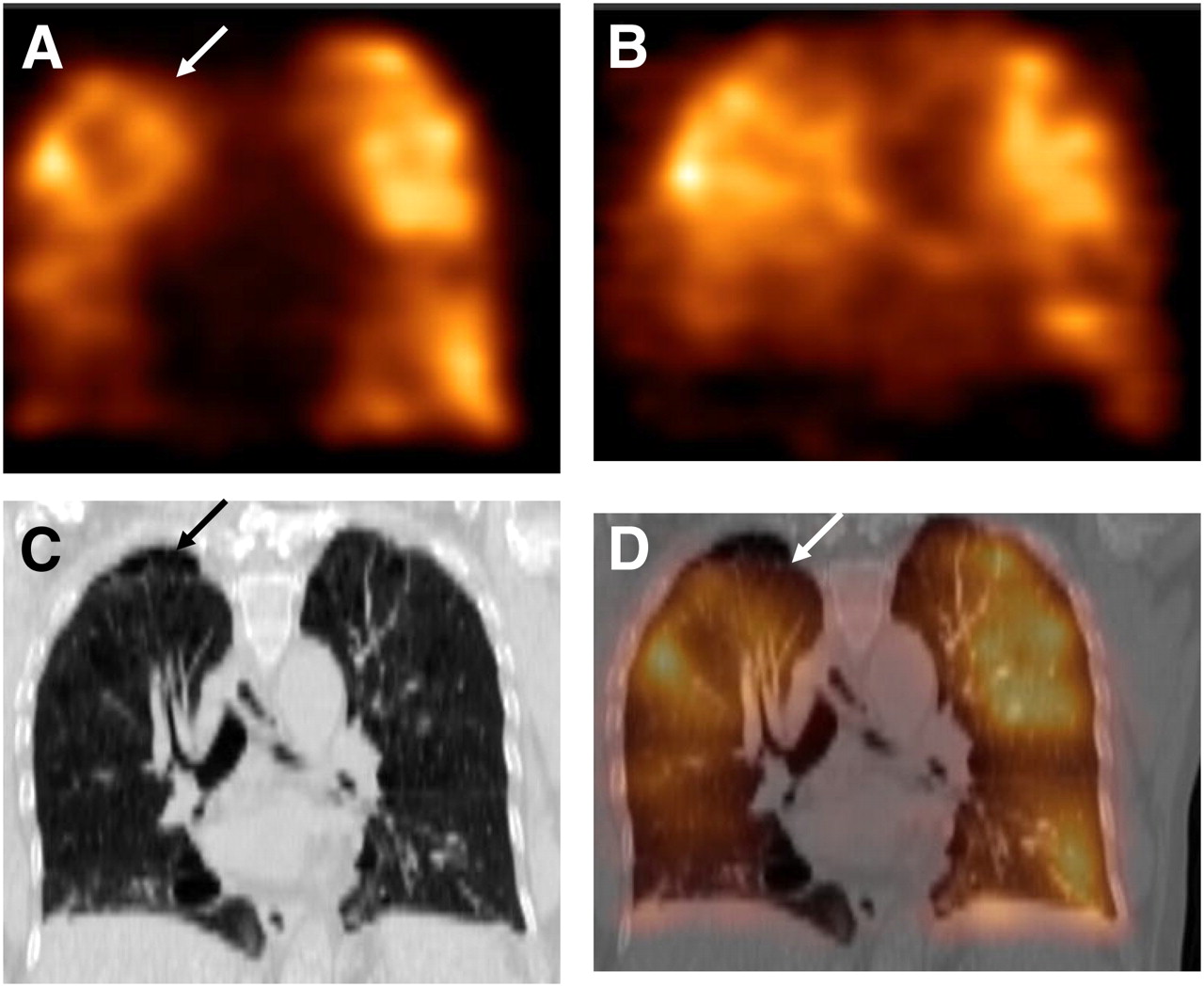
(A) Coronal perfusion SPECT revealed a moderate mismatched defect (arrow) in apex of right lung and some matched defects in both lungs. (B) Ventilation SPECT showed inhomogeneous activity in right apex and several matched defects and reversed mismatched defects (ventilation defects but normal perfusion). (C) Coronal low-dose CT revealed emphysema, and in apically mismatched area several bullae (arrow) were demonstrated. (D) Bullae and mismatched defect (arrow) in right apex corresponded on fused perfusion SPECT and low-dose CT.

(A) Axial perfusion SPECT revealed moderate mismatched defect (arrow) with decreased perfusion in right apex but normal perfusion in left apex. (B) Ventilation SPECT showed higher degree of ventilation in both apices but ventilation defect in left apex (reversed mismatch). (C) Low-dose CT revealed emphysema and several bullae (arrow) in right apex. (D) Bullae and mismatched defect (arrow) corresponded on fused perfusion SPECT and low-dose CT.
DISCUSSION
In the present study, we investigated prospectively the diagnostic performance of V/Q SPECT and pulmonary MDCT angiography alone and V/Q SPECT in combination with low-dose pulmonary CT in consecutive patients suspected of having PE. Our major findings were that V/Q SPECT alone and V/Q SPECT combined with low-dose CT had a high sensitivity, and it was higher than that of pulmonary MDCT angiography. In addition, pulmonary MDCT angiography and V/Q SPECT in combination with low-dose CT had a high specificity, whereas V/Q SPECT alone had a lower specificity. Furthermore, we demonstrated that perfusion SPECT combined with low-dose CT had a high sensitivity and a low specificity.
To our knowledge, this was the first prospective study on simultaneously obtained V/Q SPECT and pulmonary CT angiography and also the first study using a dedicated hybrid SPECT/MDCT scanner comparing the diagnostic performance of V/Q SPECT, pulmonary MDCT angiography, and V/Q SPECT combined with low-dose CT on a head-to-head basis in patients suspected of having PE.
With regard to sensitivity, specificity, and accuracy, we found good agreement with a previous retrospective study (14), which found values of 97%, 91%, and 94%, respectively, for V/Q SPECT and values of 86%, 98%, 93%, respectively, for MDCT. We found a sensitivity, specificity, and accuracy of 97%, 88%, and 91%, respectively, for V/Q SPECT; 68%, 100%, and 88%, respectively, for MDCT; and 97%, 100%, and 99%, respectively, for V/Q SPECT/low-dose CT. The PIOPED II study of the diagnostic accuracy of pulmonary MDCT angiography used a composite reference standard to establish a PE diagnosis. The reference standard included findings on V/Q lung scans (planar imaging), conventional digital subtraction angiograms, and venous sonography. The sensitivity found for pulmonary MDCT angiography was 83% (7). We had a slightly lower sensitivity of 68% for MDCT. We have no obvious explanation for the difference in sensitivity, but the differences in study populations and algorithms for final diagnosis may have been contributing factors.
To our knowledge, this was the first time perfusion SPECT with low-dose CT has been evaluated in patients with PE, and we demonstrated a high sensitivity but a significantly lower specificity. However, when ventilation SPECT was added, a significantly higher specificity and diagnostic rate were found that were similar to those of pulmonary MDCT angiography. Therefore, interpretation should be performed in the context of ventilation SPECT and not just with low-dose CT to avoid a high number of false-positive diagnostic results.
We reported all mismatched defects on SPECT as PE. Alternative reasons (14) for mismatched V/Q defects include a few, rare nonembolic diseases such as pulmonary vasculitis; extrinsic vascular compression such as vessel stenosis, lung cancer, and nodal enlargement; and therapeutic interventions such as radiation therapy (20,21). However, because we could exclude such a differential diagnosis by follow-up, anamnesis, and blood sampling and, most important, by findings on head-to-head comparisons on pulmonary MDCT angiography, we further reduced the risk of an incorrect conclusion.
Taken together, we found that V/Q SPECT in combination with pulmonary low-dose CT seems useful as a first-line routine test for PE, with excellent diagnostic performance.
At present, many centers use only pulmonary MDCT, but this might be suboptimal because of its possible lower sensitivity and higher radiation dose. Reasons for extensive use of MDCT may include its round-the-clock availability, its lower cost, its high frequency of conclusive results, and inexperience with V/Q SPECT. Recently proposed algorithms for imaging evaluation of patients suspected of having PE have omitted V/Q scintigraphy from the work-up (22), and some guidelines considered V/Q scintigraphy only as an alternative when patients cannot undergo MDCT because of severe renal insufficiency or allergy to intravenous contrast agents or when a CT-based strategy is inconclusive (23,24). A total of 46 patients (24%) were excluded from the present study because of renal dysfunction, indicating that MDCT may not be an option in many patients. This is an important strength of a scintigraphic approach.
A high frequency of equivocal tests (≤73% of all examinations in some studies (12)) previously hampered lung scintigraphy using the planar technique for diagnosing PE. Using SPECT in V/Q scintigraphy has markedly reduced the frequency of equivocal tests (25–27).
Accordingly, in our study only 4 patients (5%) had inconclusive V/Q SPECT findings. However, on MDCT and V/Q SPECT plus low-dose CT, no findings were inconclusive.
In contrast to MDCT angiography, V/Q SPECT is a functional technique, as it does not identify the embolus itself but rather its physiologic consequence, the perfusion defect. The addition of low-dose CT without contrast agent to V/Q SPECT increases confidence in the reading while reducing inconclusive studies from 5% with SPECT alone to 0% with SPECT combined with low-dose CT. In addition, specificity improves, with fewer false-positive interpretations (from 18% to 0%). This improvement is mainly due to low-dose-CT findings that give alternative explanations for subtle perfusion defects that otherwise would have been interpreted as PE on SPECT alone.
In the interpretation criteria of both the original PIOPED study and the Prospective Investigative Study of Acute Pulmonary Embolism Diagnosis, chest radiography was part of the assessment algorithm in diagnosing PE (12,28). Low-dose CT abolishes the need for chest radiography and increases sensitivity, specificity, and accuracy, compared with radiography, because of increased visualization of atelectasis, emphysema, and other lesions that might cause perfusion and ventilation defects on lung scintigraphy. Thus, the addition of low-dose CT to SPECT gives the same possibility of yielding an alternative diagnosis, as is the case with MDCT angiography. Although inherently inferior to diagnostic CT with a contrast agent, low-dose CT without a contrast agent provided satisfactorily relevant diagnostic information to determine the origin of V/Q SPECT lesions. When V/Q SPECT datasets alone were assessed, 6 patients had a false-positive diagnosis of PE, 3 patients had mismatched defects on the V/Q SPECT scans because of interlobar fissures, and 3 patients with chronic obstructive pulmonary disease had mismatched defects because of paraseptal emphysema, pneumonic infiltration, atelectasis, and pleural fluid. All these lesions were seen on low-dose CT. Our procedure requires a combined SPECT/CT scanner, and the addition of low-dose CT increases the scan time by only 1 min. Low-dose CT adds only 1 mSv to the radiation dose of 2.0 mSv from SPECT (29), comparing favorably with the 11 mSv (30) of pulmonary MDCT angiography.
V/Q SPECT combined with low-dose CT could easily be applied as a routine method. Immobilization during V/Q SPECT combined with low-dose CT lasted 20 min and was well tolerated even by critically ill patients. Only 11 of 196 were ineligible to participate because of discomfort, shortness of breath, or lack of cooperation in the supine position. Because we performed pulmonary MDCT angiography and cardiac MDCT angiography in addition to performing V/Q SPECT and low-dose CT, the patients were placed in the scanner for approximately 45 min—longer than if only a V/Q SPECT had been performed. Our experience is that only 2%−3% are not able to cooperate with V/Q SPECT, which is our daily routine procedure.
Because we excluded patients who had contraindications to MDCT angiography, the conclusions of the study apply strictly to patients who could not safely undergo MDCT angiography. Thus, whether the same results would be obtained in patients who cannot undergo MDCT angiography is unknown.
CONCLUSION
With combined scanners, lung scintigraphy performed as V/Q SPECT in combination with low-dose CT without contrast enhancement has excellent diagnostic performance and should probably be considered the first-line imaging test in the work-up of PE in most cases.
Acknowledgments
We are grateful to the technologists and radiographers at the Departments of Clinical Physiology and Nuclear Medicine, Frederiksberg Hospital, and at the Departments of Clinical Physiology, Nuclear Medicine, and PET, Rigshospitalet, for invaluable assistance.
References
- Received for publication January 22, 2009.
- Accepted for publication March 23, 2009.


Jump to section
Related Articles
Cited By...
- V/Q SPECT and SPECT/CT in Pulmonary Embolism
- Lung Scintigraphy for Pulmonary Embolism Diagnosis in COVID-19 Patients: A Multicenter Study
- V/Q SPECT/CT in the Time of COVID-19: Changing the Order to Improve Safety Without Sacrificing Accuracy
- A Prospective, Comparative Study of Ventilation-Perfusion Planar Imaging and Ventilation-Perfusion SPECT for Chronic Thromboembolic Pulmonary Hypertension
- 2019 ESC Guidelines for the diagnosis and management of acute pulmonary embolism developed in collaboration with the European Respiratory Society (ERS): The Task Force for the diagnosis and management of acute pulmonary embolism of the European Society of Cardiology (ESC)
- Diagnosis of pulmonary hypertension
- Prevalence of cerebral and pulmonary thrombosis in patients with cyanotic congenital heart disease
- Pulmonary Scintigraphy for the Diagnosis of Acute Pulmonary Embolism: A Survey of Current Practices in Australia, Canada, and France
- Ventilation-Perfusion Scanning: Stuck in a Rut, Perhaps, but the Road Ahead Is Not So Clear
- Ventilation-Perfusion Lung Scanning: Stuck in a Rut?
- V/Q Scanning Using SPECT and SPECT/CT
- V/Q SPECT: the primary imaging test for suspected pulmonary embolism
- V/Q SPECT in the diagnosis of pulmonary embolism
- Computed Tomography of Pulmonary Embolism
- Potential of hybrid V/P SPECT-low-dose CT in lung diagnostics
- SNM Practice Guideline for Lung Scintigraphy 4.0
- 68Ga PET/CT Ventilation-Perfusion Imaging for Pulmonary Embolism: A Pilot Study with Comparison to Conventional Scintigraphy
- VQ/SPECT
- Reply: Routine Use of a V/Q SPECT/Low-Dose CT Hybrid System to Diagnose Pulmonary Embolism Seems Premature
- Routine Use of a V/Q SPECT/Low-Dose CT Hybrid System to Diagnose Pulmonary Embolism Seems Premature
- Reply: Detection of Pulmonary Embolism: Comparison of Methods
- Detection of Pulmonary Embolism: Comparison of Methods
- Improving Lung Scintigraphy