


Abstract
Cigarette smoking is one of the risk factors of cardiovascular diseases and is related to abnormal peripheral and coronary vascular vasomotion. Coronary vascular endothelial dysfunction is caused by chronic smoking in smokers without epicardial coronary artery stenosis. The coronary endothelial vasomotion abnormality is restored by interventions such as l-arginine or vitamin C infusion. However, to our knowledge, the effect of smoking cessation on coronary vasomotor response has not been elucidated. Therefore, the aim of this study was to assess the effect of smoking cessation on coronary vasomotor response by quantitative myocardial blood flow (MBF) measurement using 15O-water and PET. Methods: Fifteen young smokers (Brinkman index > 100; mean age ± SD, 26 ± 4 y) with no evidence of heart disease or cardiovascular risk factors, except for smoking, and age-matched nonsmokers (n = 12) were enrolled in this study. MBF was measured at rest, during the cold pressor test (CPT), before and at 1 and 6 mo after smoking cessation. In addition, MBF measurement during adenosine triphosphate (ATP) infusion was performed before and at 6 mo after smoking cessation. In nonsmokers, MBF was measured at rest, during ATP infusion, and during the CPT. Results: MBF at rest and during ATP infusion did not differ between smokers and nonsmokers (0.73 ± 0.12 vs. 0.80 ± 0.15 mL/g/min and 3.15 ± 1.43 vs. 3.69 ± 0.76 mL/g/min, respectively; P = not significant). In contrast, MBF during the CPT in smokers was lower than that in nonsmokers (0.90 ± 0.19 vs. 1.12 ± 0.28 mL/g/min; P < 0.05). There was no significant difference in MBF either at rest or during ATP infusion between before and after smoking cessation, but MBF during the CPT increased at 1 mo in comparison with before cessation of smoking (0.90 ± 0.19 vs. 1.02 ± 0.22 mL/g/min; P < 0.01). An improvement of MBF response to the CPT was preserved at 6 mo after smoking cessation. Conclusion: Coronary vasomotor abnormality assessed by MBF response to the CPT was improved at 1 mo after smoking cessation. These findings indicate that coronary endothelial dysfunction may be reversible within 1 mo after smoking cessation in healthy young smokers.
- myocardial blood flow
- cigarette smoking
- cold pressor test
- coronary vascular endothelium
- PET
- 15O-water
- cardiovascular disease
Vascular endothelium has a very important role in regulating the integrity and metabolism of the vascular wall and encompasses the vascular structure and permeability, vasomotor tone, and homeostasis. The functional integrity of the vascular endothelium exerts important antiatherosclerotic and antithrombotic effects (1,2). Endothelial dysfunction is shown in the early stage of atherosclerosis (3–5). There is a significant inverse correlation between the extent of atherosclerosis and flow-mediated blood-flow response. It is reported that endothelial dysfunction is closely related to the prognosis of ischemic heart disease (6–8). Patients with coronary endothelial dysfunction are reported to have a higher cardiovascular event rate than those with normal coronary vasomotion (8). Therefore, the endothelial dysfunction is a significant predictor of cardiovascular events (7). The endothelial vasomotor abnormality seems to be important in assessing cardiovascular risk factors, such as hypercholesterolemia, cigarette smoking, diabetes mellitus, and hypertension. Thus, it appears that coronary endothelial dysfunction may reflect a mechanistic link that confers an increased risk of adverse cardiovascular events in smokers.
In clinical situations, coronary endothelial function is assessed by measurement of vasomotor response to intracoronary acetylcholine infusion during coronary angiography (CAG) (3,9). The cold pressor test (CPT) is used to assess coronary endothelial function (10). These methods are limited in patients with a high probability of coronary artery disease, because it is difficult to perform CAG in patients with a low likelihood of coronary artery disease. Therefore, repeated noninvasive methods that may be applicable in patients without coronary artery disease are required in clinical situations. Absolute myocardial blood flow (MBF) measurement at rest and during a CPT is used to assess coronary endothelial dysfunction (11–15).
Smoking cessation improves peripheral vasomotor response, and higher vasomotor response is shown in former passive smokers in comparison with passive smokers (16). However, an effect of cigarette smoking cessation is not fully elucidated and the time course of improvement of endothelial function after smoking cessation is unknown. Therefore, the aim of this study was to evaluate the effects of smoking cessation on coronary endothelial dysfunction in young smokers without cardiac diseases and cardiovascular risk factors, except for cigarette smoking.
MATERIALS AND METHODS
Study Subjects
Fifteen consecutive male volunteers (age range, 22−37 y; mean age ± SD, 25.8 ± 3.7 y) who had been smoking >5 y (range, 5−17 y), with 6.4 ± 2.2 pack-years (1 pack-year is defined as smoking of 20 cigarettes per day for 1 y or the equivalent), and who agreed to stop smoking for at least 6 mo were enrolled prospectively in this study. The Brinkman index was 136 ± 35, which was calculated as the number of cigarettes per day × the years of cigarette smoking. The volunteers had no cardiovascular risk factors, except for cigarette smoking. All of them agreed to refrain from cigarette smoking for at least 6 mo after the first PET study. Twelve nonsmokers' data (mean age ± SD, 26.3 ± 3.3 y) from our historical database of 46 healthy subjects without a smoking history served as control subjects. Inclusion criteria of the controls were healthy male subjects < 37 y old without cardiovascular disease and medications. Repeated MBF measurements were not performed in nonsmokers, because their data were derived from the historical database. None of the subjects had a history of cardiovascular disease, hyperlipidemia, hypertension, or diabetes mellitus, and none was receiving any medication. All had normal electrocardiograms at rest and during a stress test. All subjects refrained from caffeine-containing beverages for at least 24 h before the PET scan. The smokers refrained from smoking for at least 4 h before the first PET study. The purpose and potential risks of this study were explained to all subjects, and written informed consent was obtained. The study was approved by The Ethics Committee of Hokkaido University Graduate School of Medicine.
MBF Measurement with PET
PET data acquisition was performed using a whole-body scanner (ECAT/EXACT HR+; Siemens/CTI) as shown in Figure 1. Briefly, a dynamic 15O-water PET data acquisition for 6 min was performed after obtaining a transmission scan with an external 68Ge/68Ga source and a ventricular blood-pool scan with 15O-CO inhalation. MBF was measured using a method as previously described (11,17–20). MBF was quantified using software previously reported (21). Briefly, regions of interest (ROIs) were drawn on the whole left ventricular (LV) myocardium and within the LV cavity. The ROIs projected onto the dynamic 15O-water images. Arterial and myocardial tissue activity curves were derived with spillover correction and were fitted to a single-tissue-compartment tracer kinetic model to calculate MBF at rest and during adenosine triphosphate (ATP) infusion and the CPT. MBF measurement during the CPT was performed as previously reported (11,17). Briefly, the CPT was started after the subject's right foot was immersed in ice water. Sixty seconds later, the 15O PET scan was started, and the CPT was continued for at least 4 min. The analysis was performed blinded.

PET data acquisition is shown. MBF was measured at rest and was followed during hyperemic flow–induced adenosine triphosphate (ATP) infusion and CPT.
Refrain from Smoking and PET Scan Protocols
Fifteen subjects refrained from smoking after the first PET scan. MBF measurement was performed at 1 and 6 mo after smoking cessation. A time course and PET scan protocol are shown in Figure 2. All subjects had interviews and measurements of expiratory CO concentration randomly to ensure smoking cessation. MBF was measured at rest and during ATP infusion and the CPT before and at 6 mo after smoking cessation. MBF was assessed at rest and during the CPT at 1 mo after smoking cessation. At 6 mo after smoking cessation, PET was performed in 12 subjects, because 3 subjects abandoned smoking cessation between 2 and 5 mo after beginning smoking cessation. On the PET scan, expiratory CO concentration and plasma cotinine level were measured to evaluate a history of smoking. In addition, plasma cholesterol, high-density lipoprotein (HDL), glucose, and caffeine concentrations were measured.
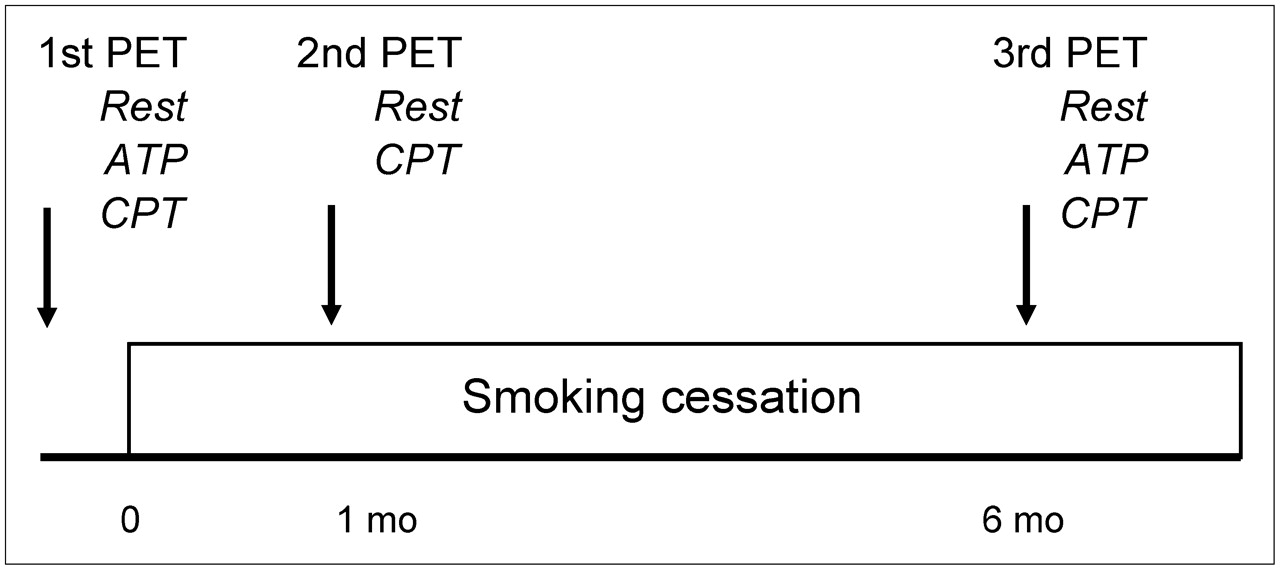
PET scan protocol before and after smoking cessation is shown. ATP = adenosine triphosphate.
Statistical Analysis
All data are presented as mean ± SD. The Mann–Whitney U test was used to compare values between smokers and nonsmokers. The changes in MBF, hemodynamics, smoking parameters, and lipid profiles before and after smoking cessation were compared using 1-way ANOVA for repeated measurements with Scheffé and Bonferroni/Dunn procedures in 12 subjects who completed smoking cessation for 6 mo. All P values < 0.05 were considered to be statistically significant.
RESULTS
PET scans were performed in all enrolled smokers and nonsmokers. Although all 15 smokers underwent PET scans before and 1 mo after smoking cessation, 3 subjects abandoned smoking cessation between 2 and 5 mo after starting smoking cessation. Three subjects did not undergo PET scans at 6 mo after smoking cessation because of a continuation of smoking after the second PET scans at 1 mo. There were no significant differences in clinical characteristics between smokers and nonsmokers. All procedures were well tolerated apart from common side effects caused by ATP, such as flushing and a feeling of tightness in the chest. Clinical characteristics of 27 subjects are shown in Table 1.
Clinical Characteristics of 27 Subjects
Hemodynamic and Smoking Parameters
All procedures were well tolerated by all volunteers. Table 2 shows blood pressure, heart rate, and rate·pressure product (RPP) at rest, during hyperemia, and during the CPT. Heart rate and RPP were significantly increased during pharmacologic vasodilation and the CPT in the smokers and the nonsmokers. Additionally, blood pressure was increased during the CPT. There were no significant differences between the smokers and the nonsmokers. None of the subjects had abnormal blood lipid profiles, elevated fasting plasma glucose level, or elevated hemoglobin A1c percentage. Cigarette smoking parameters are shown in Table 2. The smokers had an elevated serum cotinine level of 191 ± 81.8 ng/mL (range, 75−290 ng/mL) and an expiratory CO percentage of 1.7% ± 0.6% (range, 0.7%−2.7%). Serum cotinine levels were variable, depending on cigarette smoking exposure. The normal value of serum cotinine of nonsmokers was zero. The serum cotinine was not detected in 14 subjects after 1 mo of smoking cessation, expect for 1 subject who used nicotine patches after smoking cessation. The normal value of expiratory CO concentration was 0.4% ± 0.2% (range, 0.2%−0.7%).
Smoking and Hemodynamic Parameters Before and After Smoking Cessation and in Nonsmokers
Comparison Between Smokers and Nonsmokers
MBF of the smokers and the nonsmokers is shown in Table 3. There were no significant differences in MBF at rest and during ATP infusion between smokers and nonsmokers. Hyperemic flow in smokers tended to be lower than that of nonsmokers (P = 0.064). However, myocardial blood flow reserve (MFR) did not differ between smokers and nonsmokers. MBF during the CPT in smokers was significantly lower than that of nonsmokers (0.90 ± 0.19 vs. 1.12 ± 0.28; P < 0.05), indicating coronary endothelial vasomotor abnormality in the smokers.
MBF in Smokers and Nonsmokers
Effects of Smoking Cessation on Hemodynamics, Smoking Parameters, and MBF Dynamics
Smoking and hemodynamic parameters before and after smoking cessation are shown in Table 2. Serum cotinine level declined significantly from 191 ± 81.8 ng/mL to 2.1 ± 8.1 ng/mL after a 1-mo smoking cessation. At 1 mo after smoking cessation, 14 subjects had no detectable serum cotinine level. One subject showed a slightly elevated serum cotinine level of 31 ng/mL, due to use of nicotine patches to prevent smoking, but the expiratory CO concentration declined to a level of nonsmokers. Furthermore, the expiratory CO percentage decreased after starting smoking cessation from 1.7% ± 0.6% to 0.5% ± 0.2%. At 6 mo after smoking cessation, serum cotinine was not detected in any of the 12 subjects. In hemodynamic parameters, there were no significant differences between before and after smoking cessation. At 1 mo after smoking cessation, the heart rate tended to be higher than that before cessation. Therefore, the RPP at rest tended to be higher than that before cessation. Although the percentage increase of the RPP during the CPT versus that of the resting condition tended to decrease after a 1-mo smoking cessation, there were no significant differences between before and after smoking cessation.
Time Course of Vasomotor Response After Smoking Cessation
The time course of MBF changes is shown in Table 4. In addition, individual data of MBF response to the CPT and hemodynamic parameters are shown in Table 5. There were no significant changes in rest and hyperemic MBF before and after smoking cessation. On the other hand, MBF during the CPT increased after a 1-mo smoking cessation in comparison with that before smoking cessation, which was virtually similar to the level of nonsmokers. There was no significant difference in MBF during the CPT between exsmokers and nonsmokers. The increase in MBF during the CPT from MBF at rest and the ratio of MBF during the CPT to that at rest increased at 1 mo after smoking cessation. The improved coronary vasomotor response to the CPT was preserved for 6 mo after smoking cessation in 12 subjects who completed smoking cessation (ANOVA for repeated measurements).
MBF Before and After Smoking Cessation
MBF Response and Hemodynamics Before and After Smoking Cessation
Clinical Characteristics and Lipid Profiles
None of the subjects had abnormal serum lipid profiles, elevated blood glucose, or elevated glycohemoglobin A1c levels. There were no significant differences in body weight, body mass index, and lipid profiles, except for HDL cholesterol between smokers and nonsmokers. HDL cholesterol of smokers tended to be lower than that of nonsmokers (50 ± 7.4 vs. 62 ± 10 mg/dL; P = 0.052). However, all smokers enrolled in this study had normal values of serum HDL cholesterol (normal range, 41−86 mg/dL). Furthermore, changes in serum lipid profiles before and after smoking cessation are shown in Table 6. There were no significant changes in lipid profiles before and after smoking cessation (ANOVA for repeated measurements; Table 6). Serum caffeine levels were also measured in all subjects at the time of MBF measurements. In all subjects, serum caffeine was not detected.
Serum Lipid Profiles Before and After Smoking Cessation
DISCUSSION
The present study demonstrates that young healthy smokers have impaired coronary endothelial vasomotor dysfunction, which is reversible within 1 mo after smoking cessation, and the improvement is preserved at 6 mo after cessation. The improvement of coronary endothelial function is shown to be at the level of nonsmokers. Smoking cessation may prevent cardiovascular events via normalized vascular endothelial function. Although there is a possibility that smoking cessation in young smokers reduces future cardiovascular events, further long-term confirmations may be needed.
Effect of Cigarette Smoking on MBF Dynamics
Cigarette smoking is one of the important modifiable risk factors for cardiovascular diseases. It is well known that chronic cigarette smoking causes vascular endothelial dysfunction even in young smokers (11,13). Smoking causes not only endothelium-dependent vasomotor abnormality but also endothelium-independent vasomotor abnormality induced by adenosine or dipyridamole infusion (22). In this study, impaired coronary vasomotor response to the CPT was shown in smokers in comparison with nonsmokers. On the other hand, hyperemic flow induced by ATP infusion tended to be lower than that of nonsmokers in this study. The mechanisms of slightly impaired myocardial hyperemic flow in smokers may be due to an early stage of coronary atherosclerosis and impaired endothelium-dependent vasodilatation via flow-mediated vasodilatation. Some part of abnormal hyperemic flow response is attributed to coronary endothelial dysfunction (23). In the other words, impaired hyperemic flow response in smokers may be caused partially by vascular endothelial dysfunction. It may be difficult to exclude exposure of tobacco smoke for 6 mo after smoking cessation, but the possibility of smoke exposure may be low, because all subjects showed normal expiratory CO concentration and no detectable serum cotinine on the third PET scan. In addition, abnormal MBF response to CPT was normalized at 1 mo and preserved for 6 mo after smoking cessation.
Mechanisms of Endothelial Dysfunction and Reversibility by Smoking Cessation
It has been reported recently that abnormal coronary vascular function may progress from an impairment of endothelium-dependent coronary vasomotion to an impairment of the coronary vasodilatory capacity in young individuals with increasing body weight (24), which is reversible with exercise and diet modification (25). Thus, there is also a possibility that the vascular alterations in the current study population of young healthy smokers were still confined to the endothelium and had yet not affected vascular smooth muscle function. There is much evidence that cigarette smoking causes vascular endothelial damage assessed by peripheral and coronary vasomotor response (13,26–29). It is known that cigarette smoking causes abnormal coronary blood flow response to the CPT, indicating that the endothelium is the main site of toxic effects on the vascular system (28,29). Many compounds in cigarette smoke are harmful to vascular endothelium, including nicotine and CO. In this study, the serum cotinine level as a nicotine metabolite and expiratory CO declined after smoking cessation. However, improved coronary endothelial vasomotor response abnormality after smoking cessation may not be fully accounted for by a decrease in nicotine and CO concentration. Nicotine alone also causes endothelial structural damage in experimental models exposed to extremely high nicotine levels, comparable with a human smoking 50–100 cigarettes per day (30). In smokers, it was demonstrated that nicotine alone causes acute endothelial dysfunction, although to a lesser extent than smoking a cigarette of the same nicotine yield (31). Our present study subjects had no history of markedly heavy cigarette smoking. Additionally, coronary vasomotor response to the CPT improved to the level of nonsmokers within 1 mo after smoking cessation. Therefore, impaired coronary endothelial function in smokers may be a functional abnormality with reversibility, especially in young healthy smokers. Abnormal MBF response to the CPT in smokers was normalized by an infusion of l-arginine as a precursor of nitric oxide (NO), suggesting functional endothelial abnormality via NO production impairment in chronic smokers (14). In addition, impaired hyperemic flow response in smokers was normalized by vitamin C injection (22). Recently, Schindler et al. showed a precise chronologic change of myocardial vasomotor response to the CPT after starting vitamin C administration, suggesting short-term and long-term effects of vitamin C intake (15). Therefore, endothelial dysfunction in smokers is a functional abnormality, which is improved or normalized by acceleration of NO production through antioxidative interventions using vitamin C. In lipid-lowering therapy, lipid profile changes have been reported to affect MBF dynamics (32), but there were no lipid profile changes after smoking cessation in this study, indicating that the lipid profile may not contribute to improvement of MBF response to the CPT. Considering these findings, endothelial dysfunction in smokers seems to be a functional deterioration that is reversible, and lifestyle modifications, such as smoking cessation, may be important to improve endothelial dysfunction, reducing the rate of cardiovascular events.
Clinical Implications
The current study provides important noninvasive mechanistic insight into the early functional stages of the development of coronary artery disease in smokers. Furthermore, the functional recovery of coronary endothelial dysfunction after smoking cessation was determined in serial PET studies. The data of the current study emphasize the importance of smoking cessation in smoking-related endothelial dysfunction in young healthy smokers, which should be regarded as an important strategy for altering the cardiovascular risk at an early age (25). This study demonstrated that coronary endothelial dysfunction is normalized within 1 mo of smoking cessation in young smokers, which may encourage young smokers to refrain from cigarette smoking. On the other hand, it seems that >1 mo may be required to improve endothelial dysfunction in middle-age or old-age smokers, because atherosclerosis may have progressed or they may have other cardiovascular risk factors.
Limitations
One of the major limitations of the current study is the small number of subjects. In addition, females and elderly smokers were not enrolled in this study. However, a significant improvement in response to the CPT at 1 mo after smoking cessation was obtained with the current number of subjects. Hyperemic MBF was not measured at 1 mo in this study to reduce radiation exposure. In this study, hyperemic MBF was not significantly decreased in smokers compared with nonsmokers, in spite of a trend of impaired hyperemic flow in smokers. Myocardial hyperemic flow was reported to be attenuated in middle-age smokers, which may be partially caused by endothelial dysfunction attributed to chronic smoking (22). There may be a discrepancy in the time course between hyperemic and endothelial functional improvement in middle-age or old-age smokers. In the present study, young male smokers were enrolled mainly to exclude the effects of humoral factors, such as estrogen. Further study is necessary to evaluate the effect of smoking cessation in females. This may require a reproducibility study to confirm the MBF response to the CPT. The measurement of MBF using 15O-water PET has been well validated (33,34). Moreover, a close relationship between MBF response and coronary vasomotion was clearly validated by assessing the correlation between quantitative coronary angiography and the CPT (35). In addition, excellent repeatability of the MBF response to CPT has been reported (36). However, considering these findings, the MBF response to the CPT may be reliable, because there was no difference in the MBF during the CPT between 1 mo and 6 mo after smoking cessation.
CONCLUSION
Coronary vasomotor abnormality assessed by MBF response to the CPT was improved at 1 mo after smoking cessation. The findings indicate that coronary endothelial dysfunction may be reversible within 1 mo after smoking cessation in healthy young smokers.
Acknowledgments
We thank radiologic technologists Kotaro Suzuki and Hidehiko Omote for excellent technical assistance and PET scanning. This work was partially supported by Suzuken-Memorial Foundation and by the Smoking Research Foundation of Japan.
Footnotes
-
COPYRIGHT © 2006 by the Society of Nuclear Medicine, Inc.
References
- 1.↵
- 2.↵
- 3.↵
- 4.
- 5.↵
- 6.↵
- 7.↵
- 8.↵
- 9.↵
- 10.↵
- 11.↵
- 12.
- 13.↵
- 14.↵
- 15.↵
- 16.↵
- 17.↵
- 18.
Iida H, Kanno I, Takahashi A, et al. Measurement of absolute myocardial blood flow with
 and dynamic positron-emission tomography: strategy for quantification in relation to the partial-volume effect. Circulation. 1988;78:104–115.
 - 19.
- 20.↵
- 21.↵
- 22.↵
- 23.↵
- 24.↵
- 25.↵
- 26.↵
- 27.
- 28.↵
- 29.↵
- 30.↵
- 31.↵
- 32.↵
- 33.↵
- 34.↵
- 35.↵
- 36.↵
Siegrist PT, Gaemperli O, Koepfli P, et al. Repeatability of cold pressor test-induced flow increase assessed with and PET. J Nucl Med. 2006;47:1420–1426.


- Received for publication May 6, 2006.
- Accepted for publication September 5, 2006.


Jump to section
Related Articles
Cited By...
- Impact of Revascularization on Absolute Myocardial Blood Flow as Assessed by Serial [15O]H2O Positron Emission Tomography Imaging: A Comparison With Fractional Flow Reserve
- Quantitative Assessment of Coronary Microvascular Function: Dynamic Single-Photon Emission Computed Tomography, Positron Emission Tomography, Ultrasound, Computed Tomography, and Magnetic Resonance Imaging
- Association of Smoking Status With Health-Related Outcomes After Percutaneous Coronary Intervention
- The Clinical Value of Myocardial Blood Flow Measurement