


Abstract
Based on our earlier observation that 99mTc-UBI 29-41, a radiolabeled peptide derived from ubiquicidin (UBI), discriminates between infections and sterile inflammatory processes, we considered the possibility that this tracer could be used for monitoring the efficacy of antibacterial agents in animals infected with Staphylococcus aureus. Methods: We injected 99mTc-UBI 29-41 into S. aureus–infected mice after treatment with various doses of cloxacillin or erythromycin. At intervals thereafter, accumulation of the radiolabeled peptide at the site of infection was assessed by scintigraphy. When S. aureus was antibiotic resistant, we evaluated the efficacy of hLF 1-11, an antimicrobial peptide derived from human lactoferrin (hLF), in rats using 99mTc-UBI 29-41 and scintigraphy. Results: Decreasing amounts of radiolabeled peptide at the site of the S. aureus infection in animals correlated (r2 > 0.81; P < 0.001) with increasing doses of cloxacillin in animals. An effective dose of erythromycin resulted in reduced (P = 0.023) accumulation of the radiolabeled peptide at the site of S. aureus infection in mice. In addition, we noted decreasing amounts of 99mTc-UBI 29-41 at the site of infection after administration of increasing doses of hLF 1-11 peptide in rats infected with antibiotic-resistant S. aureus. Furthermore, the number of viable bacteria decreased with increasing doses of cloxacillin or hLF 1-11 peptide, and a good correlation (r2 > 0.80; P < 0.001) between the accumulation of 99mTc-UBI 29-41 and the number of viable (antibiotic-resistant) S. aureus at the site of infection was seen. In an attempt to explain these results, we found that these antibacterial agents do not affect the in vitro binding of 99mTc-UBI 29-41 to bacteria. Furthermore, this radiolabeled peptide bound to free bacteria and to cell-adherent but not phagocytized S. aureus, suggesting that at sites of infection mainly extracellular bacteria are targeted by 99mTc-UBI 29-41. Conclusion: 99mTc-UBI 29-41 allows the monitoring of the efficacy of antibacterial agents in mice and rats with S. aureus infections.
- antibiotics
- infection
- lactoferrin peptide
- monitoring therapy
- Staphylococcus aureus
- 99mTc labeling
- ubiquicidin peptide
On the basis of medical history, physical examination, imaging studies, and laboratory tests, the clinician determines whether signs and symptoms in patients are suggestive of an infectious or noninfectious cause. Moreover, in patients with serious underlying conditions, the identification of infection and initiation of treatment (which is established in the context of appropriate local and wider antibiotic resistance trends) at early stages of the disease are critical for a favorable outcome. At the start of the antibacterial treatment, microbiologic cultures are performed to identify the infectious agent and its in vitro susceptibility to antibiotics. The latter results may or may not correlate with clinical outcome. In addition, the prescription of antibiotics based on pharmacodynamic principles that predict bacterial eradication and prevent the emergence of resistance is important to the success of therapy (1). In view of the need to reduce resistance emergence and to minimize costs, the ability to monitor the efficacy of antimicrobial agents can be an important asset. In this connection, scintigraphic quantification of the accumulation of 99mTc-labeled UBI 29-41 at the site of infection may be an option. 99mTc-labeled UBI 29-41 is a radiolabeled synthetic fragment of ubiquicidin that preferentially binds to bacteria and fungi over mammalian cells (2,3). In support of this suggestion, we found that this radiolabeled peptide distinguishes bacterial and fungal infections from sterile inflammatory processes (3–5). Moreover, a significant correlation between accumulation of 99mTc-UBI 29-41 and the number of viable bacteria at the site of infection was noted (6). Based on these considerations, the aim of this study was to investigate the possibility of monitoring the efficacy of antibacterial therapy in infected mice using 99mTc-UBI 29-41 and scintigraphy.
MATERIALS AND METHODS
Antibiotics and Synthetic Antimicrobial Peptides
Cloxacillin (sodium salt, 91% activity; Beecham) and erythromycin (base, 98% activity; Abbott N.V.) were dissolved in pyrogen-free, phosphate-buffered saline (PBS; pH 7.4). The peptides GRRRRSVQWCA (1,494 Da), corresponding to the first 11 N-terminal residues of human lactoferrin (hLF 1-11 (7)), and TGRAKRRMQYNRR (1,693 Da), corresponding to residues 29-41 of ubiquicidin (UBI 29-41), were synthesized and purified as described elsewhere (7,8). Peptides were diluted to stock concentrations of 1 mmol/L in 0.01% acetic acid (HAc; pH 4) and stored at −20°C.
Labeling Procedure and Quality Control
UBI 29-41 was labeled with 99mTc as described elsewhere (4). Briefly, 10 μL peptide stock solution were added to 4 μL of an aseptic mixture of 950 mg/L stannous chloride2H2O and 2 g/L sodium pyrophosphate10H2O in saline in a 1.5-mL Eppendorf vial. Immediately thereafter, 2 μL of a solution containing 10 mg/mL potassium borohydrate crystalline; Sigma Chemical Co.) in 0.1 mol/L sodium hydroxide were pipetted into this mixture. After the addition of 0.1 mL 99mTc-sodium pertechnetate solution (approximately 200 MBq/mL, Technekow; Mallinckrodt Medical BV), the mixture was gently stirred at room temperature for at least 10 min and then was ready for use. This preparation is referred to here as 99mTc-UBI 29-41. Radiochemical analysis using reverse-phase high-performance liquid chromatography and instant thin-layer chromatography as described elsewhere indicated that free 99mTc-activity and 99mTc-colloids in the solutions containing 99mTc-UBI 29-41 did not exceed 5% (9). The specific activity of 99mTc-UBI 29-41 (2,000 TBq/mol peptide [0.1 μCi/μg peptide]) remained stable at least 24 h in human serum (9).
Microorganisms
Staphylococcus aureus 25923 (American Type Culture Collection) was susceptible to cloxacillin (minimum inhibitory concentration [MIC] < 2 mg/L) and erythromycin (MIC < 0.2 mg/L). The clinical isolate S. aureus 4121 was highly resistant to a variety of antibiotics, including methicillin (MIC > 256 mg/L), cloxacillin (MIC > 256 mg/L), and erythromycin (MIC > 2 mg/L) (7). Overnight cultures of bacteria were prepared in brain/heart infusion broth (Oxoid) in a shaking water-bath at 37°C. Virulent strains of bacteria were maintained by passage in Swiss mice. Briefly, about 1 × 10⁷ colony-forming units (CFU) of bacteria were injected into tail veins, and 24 h thereafter the mice were killed. The spleens were aseptically removed and homogenized, and serial dilutions of the homogenate were plated onto diagnostic-sensitivity test agar (Oxoid). A single CFU was transferred into 25 mL of the appropriate broth and incubated for 24 h at 37°C, and aliquots of these suspensions containing about 1 × 10⁹ virulent bacteria per milliliter of broth were stored at −70°C. In addition, stocks of heat-killed bacteria boiled for 2 h at 100°C were prepared and stored at −20°C.
Animals
Specific pathogen-free (SPF) male Swiss mice (weight range, 20–25 g) and SPF female Wistar rats (weight range, 175–200 g) purchased from Charles River Netherlands were used in this study. The animals were housed in the animal housing facilities of the LUMC for at least 1 wk before the start of experiments. Food and water were given ad libitum. All animal studies were performed in compliance with Dutch laws related to the conduct of animal experiments and were approved by the local Committee for Animal Experiments (protocols 99016 and 02029).
Treatment of Infections in Animals with Antibacterial Agents
Mice were anesthetized with a single intraperitoneal injection of 0.1 mL saline containing 11 μg fentanyl citrate and 0.333 mg fluanisone (Hypnorm; Janssen Pharmaceutics). Next, approximately 2 × 10⁶ CFU of bacteria in 0.1 mL saline were aseptically injected into the right thigh muscle. Mice received various doses of cloxacillin (range, 0–500 mg/kg) or an optimal dose of erythromycin (10 mg/kg) subcutaneously in the nuchal region at 1 h after infection (10). Because S. aureus 4121 is highly resistant to cloxacillin and erythromycin, rats infected with this bacterium (inoculum size was approximately 2 × 10⁶ CFU in 0.1 mL saline) were injected intravenously with the antimicrobial peptide hLF 1-11 (0–40 μg/kg) at 1 h after the infection had been introduced (7). Control mice and rats received saline instead of antibiotics and antimicrobial peptide. After scintigraphy, the animals were killed by intraperitoneal injection of sodium barbiturate (60 mg/mL saline, Nembutal; Sanofi BV). Next, the entire infected muscles were removed, weighed, and homogenized, and the number of bacteria was determined microbiologically. The detection limit was set at 1,000 viable bacteria per gram of infected tissue.
Scintigraphy
At 18 h after being infected, mice were anesthetized as described previously and 0.05 mg diazepam (Valium; Hoffmann-Roche) in 0.1 mL saline was administered subcutaneously to induce muscle relaxation. Rats were immobilized by an intravenous injection of 100–150 μL sodium barbiturate. Next, mice and rats were placed in the supine position on a low-energy, all-purpose collimator of a planar γ-camera (GCA 7100/UI; Toshiba) with both hind legs spread out and fixed with surgical tape. At various intervals up to 2 h after 99mTc-UBI 29-41 injection, whole-body images were acquired and radioactivity counts were collected in a 512 × 512 matrix using a window of 20% at 140 keV. On the scintigrams, anatomically adjusted regions of interest were drawn over the entire infected (target [T]) and contralateral (nontarget [NT]) muscle. Accumulation of the tracer at sites of infection was expressed as the ratio of the counts in the target and the nontarget muscles (T/NT). After scintigraphy, animals were sacrificed by an intraperitoneal injection of sodium barbiturate.
Binding of 99mTc-UBI 29-41
Binding of 99mTc-UBI 29-41 to (antibiotic-resistant) S. aureus was assessed at 4°C as described elsewhere (9). In short, 0.1 mL 15 mmol/L sodium phosphate buffer (PB; pH 7.5) containing 10% (v/v) of the preparation containing the radiolabeled peptide 99mTc-UBI 29-41 solution was transferred to an Eppendorf vial. Next, 0.8 mL PB containing 0.1% (v/v) HAc and 0.01% (v/v) Tween-80 and then 0.1 mL PB containing 2 × 10⁷ CFU bacteria were added. The final pH of this mixture was approximately 5, mimicking the pH value at sites of infection. In some of our experiments, bacteria were preincubated with 100 μg cloxacillin, erythromycin, or hLF 1-11 for 1 h at 37°C, washed with PB, and then incubated with 99mTc-UBI 29-41 as described previously. Next, the vials containing bacteria were centrifuged in a precooled centrifuge at 1,000g for 5 min, the supernatant was removed, and the pellet was gently resuspended in 1 mL incubation buffer and recentrifuged. The supernatant was removed, and the radioactivity in the pellet containing bacteria was determined in a dose calibrator. The radioactivity associated with bacteria was expressed as percentage of added 99mTc activity/2 × 107 CFU or heat-killed bacteria. Values were corrected for the nonspecific binding of the peptide to the plastic surface of the vial.
Isolation and Activation of Human Granulocytes
Human granulocytes were purified from buffycoats of healthy volunteers by density centrifugation. Briefly, buffycoats were diluted in PBS and then subjected to ficol-amidotrizoate (P = 1.077 g/mL; Pharmacia) density centrifugation at 440g for 20 min. Contaminating erythrocytes were removed by single hypotonic lysis. The cells in pellets containing the granulocytes were washed 3 times with PBS. Viability of the granulocyte preparation exceeded 95%, as determined by trypan blue dye exclusion. Activation of the granulocytes was achieved by exposure of the cells to 100 nmol/L formyl-Met-Leu-Phe (Sigma) for 15 min at 37°C (11). Next, the cells were washed and resuspended to a concentration of 2 × 10⁷ granulocytes/mL PBS supplemented with 50 units heparin and 10% (vol/vol) human serum.
Phagocytosis of S. aureus by Human Granulocytes
Phagocytosis of bacteria by granulocytes was performed as described elsewhere (11). In short, equal volumes of 1 × 10⁶ granulocytes and 1 × 10⁷ serum-opsonized bacteria were incubated at 37°C under slow rotation (4 rpm) or as a negative control at 4°C. After 1 h, the cell suspensions were centrifuged for 5 min at 110g at 4°C and were washed with PBS, and the fractions containing granulocytes with bacteria and those containing free bacteria were harvested. To discriminate between cell-adherent and phagocytized bacteria, half of the suspension containing granulocytes with bacteria was exposed for 5 min to 10 units of lysostaphin/mL at 5°C, which lyses adherent S. aureus, and then washed with PBS (referred to here as granulocytes with phagocytized bacteria), whereas the other half of the cell suspension was washed with PBS (referred to here as granulocytes with cell-adherent and phagocytized bacteria).
Binding of 99mTc-UBI 29-41
Briefly, granulocytes with phagocytized bacteria, granulocytes with cell-adherent and phagocytized bacteria, and granulocytes at a concentration of 1 × 10⁷ granulocytes/mL PBS were incubated for 1 h at 4°C with 1 nmol 99mTc-UBI 29-41. After 3 washes with PBS, the granulocytes were transferred to a dose calibrator. The radioactivity associated with granulocytes was expressed as percentage of added 99mTc-activity/1 × 107 granulocytes. Values were corrected for the nonspecific binding of the peptide to the plastic surface of the vial.
Statistical Analysis
Differences between T/NT before and after treatment of mice with antibacterial agents were evaluated using the Student t test. The 2-sided P values were calculated, and statistical significance was accepted within 95% confidence limits. All results were reported as means and SEM. The Pearson correlation coefficient was used to assess the correlation between T/NT and the number of viable bacteria.
RESULTS
Effect of Antibiotics on the Amount of 99mTc-UBI 29-41 at Infection Site
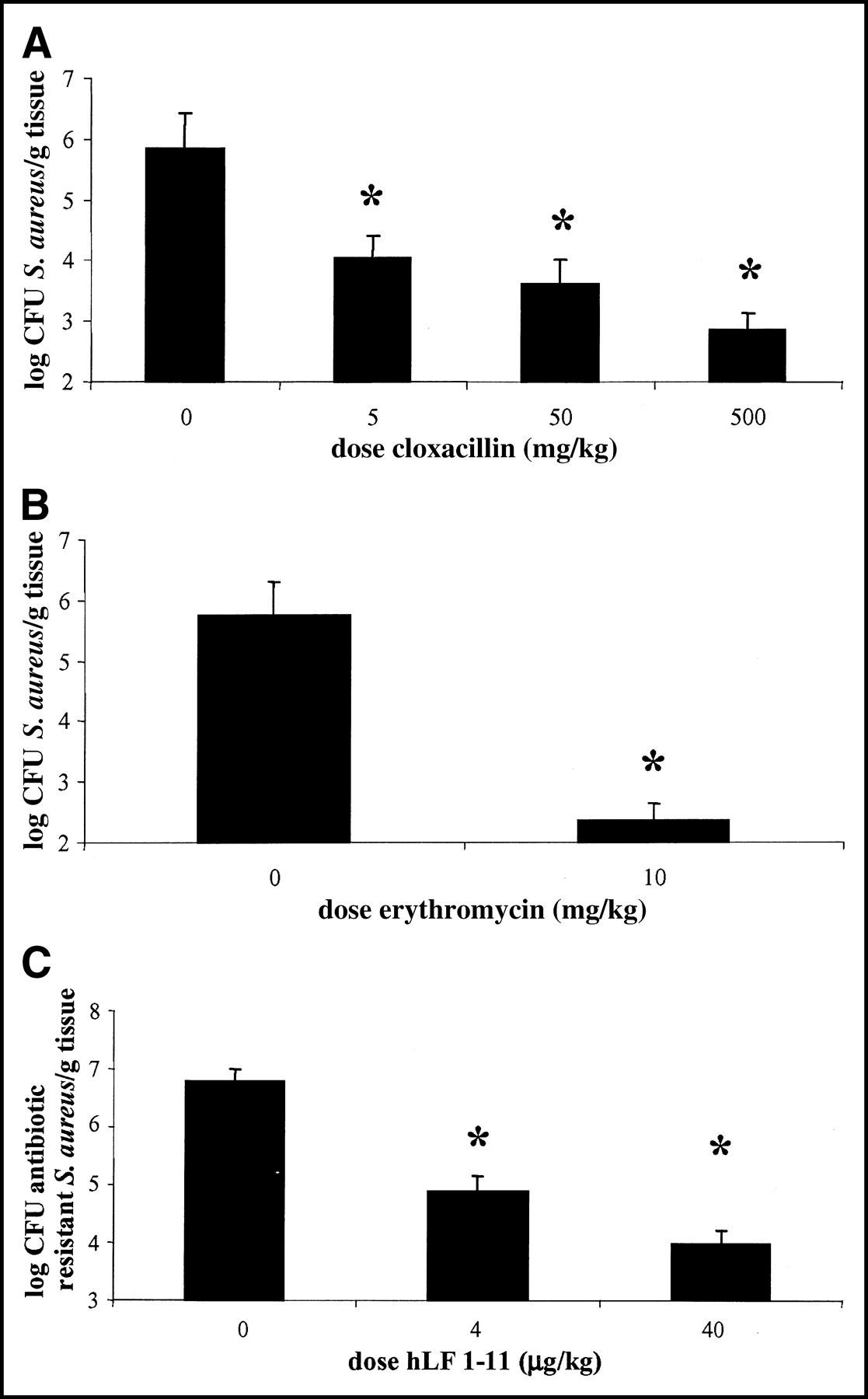
To establish whether the efficacy of antibiotic treatment can be monitored with 99mTc-UBI 29-41 and scintigraphy, we determined the effect of various doses (range, 0–500 mg/kg) of cloxacillin on the accumulation of 99mTc-UBI 29-41 in thigh muscles of mice infected with S. aureus. The results revealed decreasing amounts of 99mTc-UBI 29-41 at the site of infection with increasing doses of this bactericidal antibiotic (r = −0.909; P < 0.001; 2 experiments, each with 3 mice per group) (Fig. 1A). Treatment with cloxacillin at 1 h after infection resulted in a significant (P < 0.001) decrease in the number of viable S. aureus measured 18 h thereafter (Fig. 2A), and we calculated a good correlation between the amount of the radiolabeled peptide and the number of viable bacteria at the site of infection (r = 0.915; P < 0.05; 2 experiments, each with 3 mice per group). In addition, treatment of S. aureus–infected mice (n = 9) with 10 mg erythromycin/kg revealed a significant (P = 0.023) decrease in the amount of 99mTc-UBI 29-41 (Fig. 1B) and a reduction (P = 0.022) in the number of surviving bacteria in the infected thigh muscle (Fig. 2B). Together, these results revealed a good correlation (r = 0.915, P < 0.001) between the amount of 99mTc-UBI 29-41 and the number of viable S. aureus at the site of infection. From these data we calculated that the lower limit of detection (T/NT = 1.3) in mice amounted to 103 CFU S. aureus per gram infected tissue. In addition, cloxacillin and erythromycin did not affect the in vitro binding of 99mTc-UBI 29-41 to S. aureus (Table 1). The effect of 50 mg/kg cloxacillin or 10 mg erythromycin/kg on the accumulation of 99mTc-UBI 29-41 in S. aureus–infected mice is depicted in scintigrams at 2 h after injection of the tracer (Figs. 3B and 3C).
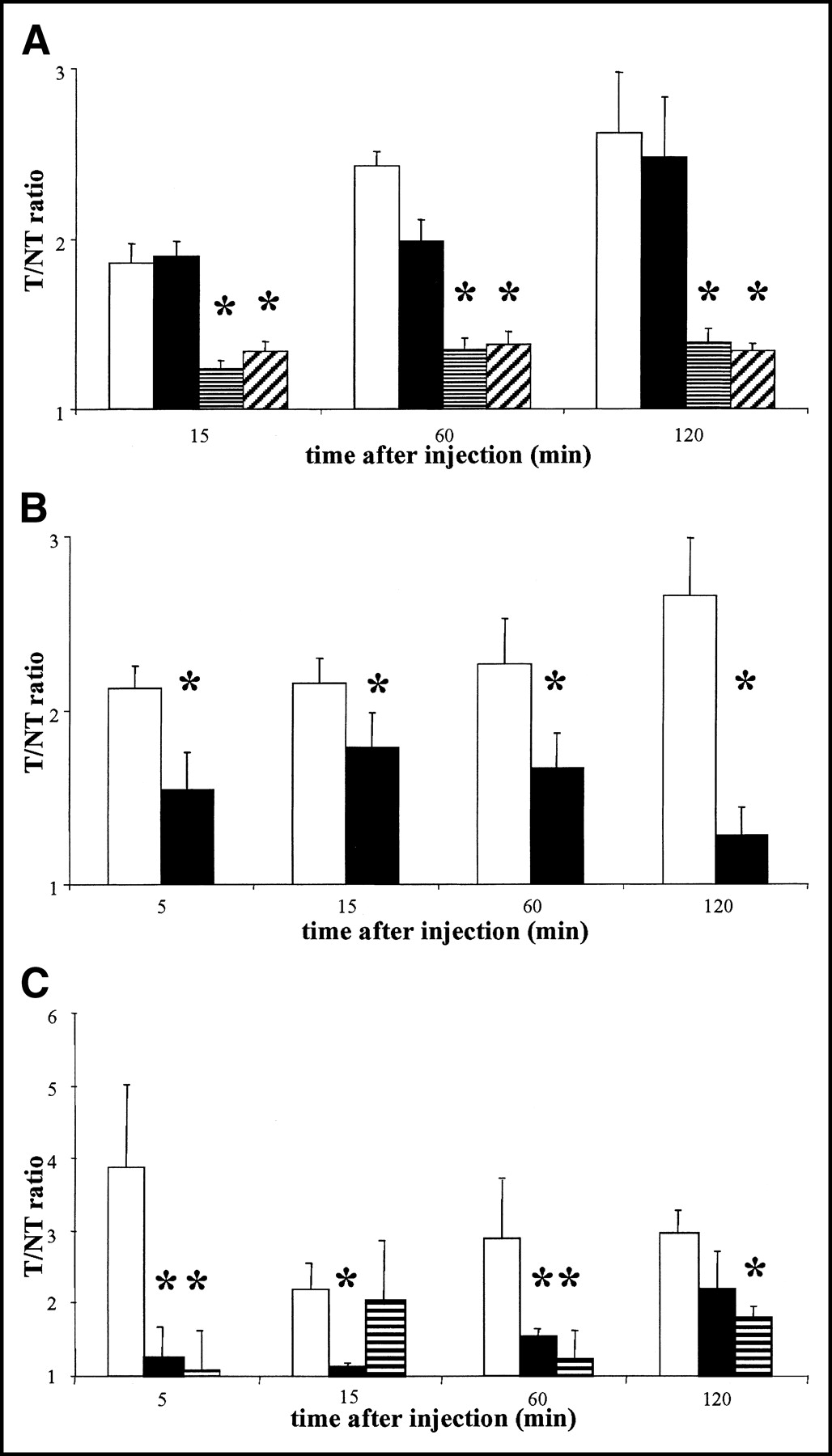
(A) Mice infected with S. aureus were injected subcutaneously with various doses of cloxacillin. Accumulation of 99mTc-UBI 29-41 in the infected thigh muscles of untreated (open bars) mice or animals treated with 5 mg/kg (closed bars), 50 mg/kg (horizontally hatched bars), or 500 mg/kg (diagonally hatched bars) cloxacillin is expressed as T/NT (plus SEM) of at least 4 mice. (B) Mice infected with S. aureus were injected subcutaneously with erythromycin. Accumulation of 99mTc-UBI 29-41 in the infected thigh muscles of untreated (open bars) mice or animals treated with 10 mg/kg erythromycin (closed bars) is expressed as T/NT (plus SEM) of at least 4 mice. (C) Rats infected with antibiotic-resistant S. aureus were injected intravenously with various doses of hLF 1-11. Accumulation of 99mTc-UBI 29-41 in the infected thigh muscles of untreated (open bars) rats or animals treated with 4 μg/kg (closed bars) or 40 μg/kg (horizontally hatched bars) hLF 1-11 is expressed as T/NT (plus SEM) of at least 4 rats. *Values that were significantly (P < 0.05) different from those in untreated rats.
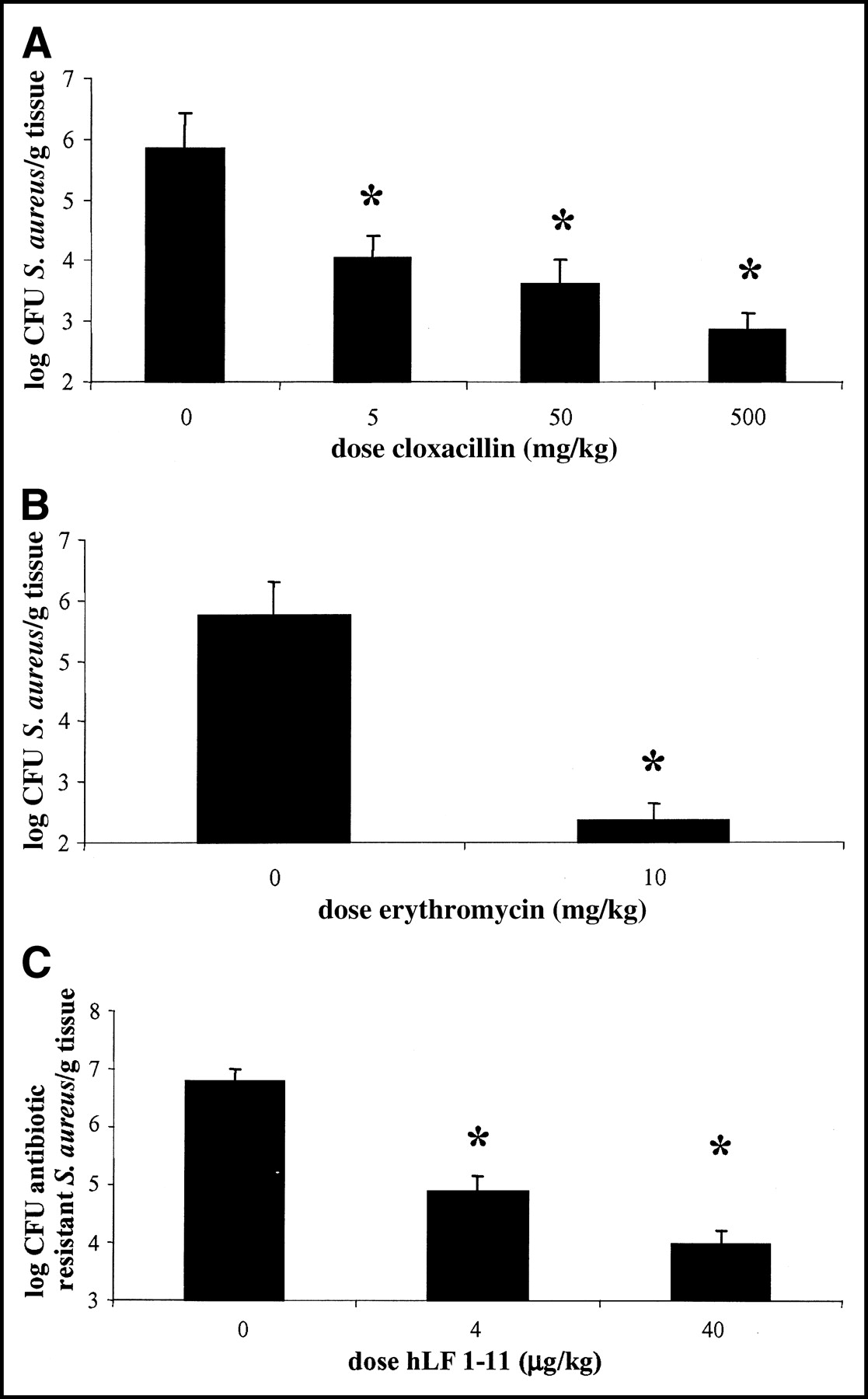
Effect of various doses of cloxacillin (A), erythromycin (B), and hLF 1-11 (C) on the number of viable bacteria in animals infected with S. aureus or antibiotic-resistant S. aureus. Values are means (plus SEM) CFU per gram of thigh muscle at 24 h after injection of the antibacterial agent (n > 4 for each bar). *Values significantly different from those in untreated animals.
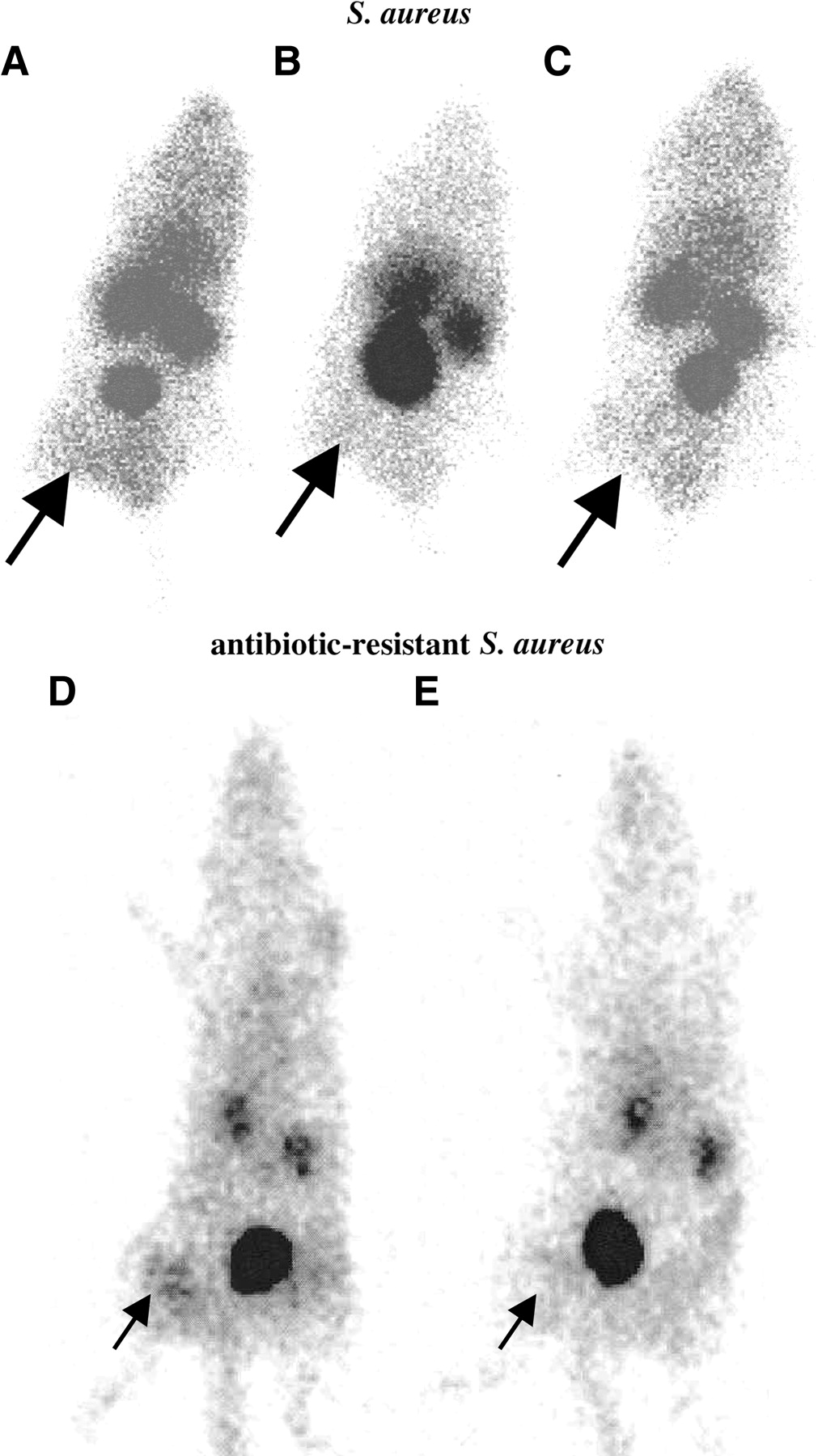
Typical scintigrams of mice with S. aureus infection (A–C) intravenously injected with 2–7 MBq 99mTc-UBI 29-41 after treatment with 50 mg/kg cloxacillin (B), 10 mg/kg erythromycin (C), or no antibiotic (A). In addition, typical scintigrams of rats with antibiotic-resistant S. aureus infection (D and E) intravenously injected with 2–7 MBq 99mTc-UBI 29-41 after treatment with 40 μg/kg hLF 1-11 (E) or no peptide (D). Arrows indicate the infected thigh muscle.
In Vitro Binding of 99mTc-Labeled UBI 29-41 to Antibiotic-Resistant S. aureus Treated with Antimicrobial Compounds
Effect of hLF 1-11 Peptide on the Amount of 99mTc-UBI 29-41 at the Site of Infection
Treatment of rats infected with antibiotic-resistant S. aureus with the antimicrobial peptide hLF 1-11 resulted in a dose-dependent decrease in the amount of 99mTc-UBI 29-41 at the site of infection at 2 h after injection of the tracer (Fig. 1C) and in the number of viable bacteria (Fig. 2C). The effect of 40 μg/kg hLF 1-11 on the accumulation of 99mTc-UBI 29-41 in antibiotic-resistant S. aureus–infected thigh muscles in rats is depicted in the scintigram at 2 h after injection of the tracer (Fig. 3E). In addition, the hLF 1-11 peptide did not affect the in vitro binding of 99mTc-UBI 29-41 to bacteria (Table 1).
In Vitro Binding of 99mTc-UBI 29-41
Because 99mTc-UBI 29-41 preferentially binds to bacteria over mammalian cells, we also wanted to investigate whether this tracer binds to phagocytized S. aureus or cell-adherent or free bacteria (3). The results revealed that 99mTc-UBI 29-41 binding to granulocytes with phagocytized and cell-adherent S. aureus amounted to 43% ± 5% of the total added radioactivity (n = 4). Binding of 99mTc-UBI 29-41 to granulocytes with phagocytized bacteria was significantly (P < 0.01) decreased (16% ± 1.4% of the total added radioactivity) and was not significantly higher than binding to granulocytes without bacteria. Control experiments revealed that lysostaphin did not affect the binding of 99mTc-UBI 29-41 to bacteria or granulocytes. The respective values for S. aureus bacteria and granulocytes exposed or not to lysostaphin amounted to 38% ± 6%, 33% ± 9%, 13% ± 2%, and 12% ± 3% of the total added radioactivity (n = 4). Together these data indicate that 99mTc-UBI 29-41 does not bind to phagocytized bacteria. Furthermore, we observed that in vitro binding of 99mTc-UBI 29-41 to heat-killed bacteria and viable bacteria did not differ, with respective values of 41% ± 2.5% and 42% ± 4% for S. aureus and 41% ± 3.9% and 40% ± 1.5% for antibiotic-resistant S. aureus (n = 4).
DISCUSSION
The main finding of this study is that the efficacy of antibiotics and antimicrobial peptides in mice infected with S. aureus can be monitored using 99mTc-UBI 29-41 and scintigraphy. In addition, the efficacy of an antimicrobial peptide against infections with antibiotic-resistant S. aureus in rats could be monitored with this radiolabeled peptide without competition between the therapeutic peptide and the tracer peptide (7).
This conclusion is based on 2 lines of evidence. First, we found good (inverse) correlations between accumulation of 99mTc-UBI 29-41 at the site of infection and the dose of antibacterial agents administered to the mice. In addition, we observed a good correlation between the accumulation of 99mTc-UBI 29-41 and the numbers of viable S. aureus at the site of infection, which is in agreement with our earlier results (9). Because the binding of 99mTc-UBI 29-41 to (antibiotic-resistant) S. aureus was not affected by exposure of the bacteria to effective doses of cloxacillin, erythromycin, or hLF 1-11 peptide, the possibility that the antibacterial agents used in this study interfered with the binding of 99mTc-UBI 29-41 to bacteria can be excluded. Therefore, it is highly likely that the accumulation of 99mTc-UBI 29-41 reflects the number of viable bacteria at the site of infection.
Second, injection of large numbers of heat-killed (or UV-inactivated) S. aureus into the thigh muscle of mice did not result in a significant accumulation of 99mTc-UBI 29-41 at the site of infection (3–5), indicating that the accumulation of 99mTc-UBI 29-41 does not involve binding of this tracer to dead bacteria at the site of infection. Interestingly, in our in vitro binding study 99mTc-UBI 29-41 bound equally well to heat-killed and viable S. aureus (Table 1). Although we cannot offer a definitive explanation for these contradictory findings, it is probable that dead bacteria at the site of infection are rapidly degraded or internalized by phagocytes. Our observation that 99mTc-UBI 29-41 does not bind to phagocytized bacteria is in agreement with this suggestion.
These results indicate the potential of radiolabeled antimicrobial peptides for evaluating the efficacy of antibiotic therapy, which may be of considerable value in clinical practice. However, it should be recognized that the minimal number of bacteria that can be detected with 99mTc-UBI 29-41 is 103–104 bacteria, which is a limitation of this noninvasive approach for monitoring the effects of antibacterial agents. Another limitation of our approach is that infections with (facultative) intracellular bacteria cannot be detected, because the peptide does not target phagocytized bacteria. Furthermore, it is unlikely that the 99mTc-UBI 29-41 peptide used in this study to detect infections caused a decrease in the number of viable bacteria, because nonbactericidal amounts of UBI 29-41 were used (5).
CONCLUSION
99mTc-UBI 29-41 allows the monitoring of the efficacy of antibacterial agents in mice and rats with S. aureus infections.
Acknowledgments
We thank Sylvia J.P. Bogaards and Pablo Escuder for their help with the rat experiments.
Footnotes
Received Jul. 23, 2003; revision accepted Oct. 23, 2003.
For correspondence or reprints contact: Peter H. Nibbering, PhD, Department of Infectious Diseases, Leiden University Medical Center (LUMC), C5-P, P.O. Box 9600, 2300 RC Leiden, The Netherlands.
E-mail: p.h.nibbering{at}lumc.nl
In this issue



Jump to section
Related Articles
Cited By...
- 68Ga-NOTA-Functionalized Ubiquicidin: Cytotoxicity, Biodistribution, Radiation Dosimetry, and First-in-Human PET/CT Imaging of Infections
- 68Ga-NOTA-UBI-29-41 as a PET Tracer for Detection of Bacterial Infection
- Imaging Enterobacteriaceae infection in vivo with 18F-fluorodeoxysorbitol positron emission tomography
- Preclinical Evaluation of 68Ga-Labeled 1,4,7-Triazacyclononane-1,4,7-Triacetic Acid-Ubiquicidin as a Radioligand for PET Infection Imaging
- Antimicrobial Peptide hLF1-11 Directs Granulocyte-Macrophage Colony-Stimulating Factor-Driven Monocyte Differentiation toward Macrophages with Enhanced Recognition and Clearance of Pathogens
- Comparison of 99mTc- and 18F-Ubiquicidin Autoradiography to Anti-Staphylococcus aureus Immunofluorescence in Rat Muscle Abscesses
- Leukocyte Receptor-Binding Radiopharmaceuticals for Infection and Inflammation Scintigraphy
- Antimicrobial Peptide 99mTc-Ubiquicidin 29-41 as Human Infection-Imaging Agent: Clinical Trial
- The Synthetic N-Terminal Peptide of Human Lactoferrin, hLF(1-11), Is Highly Effective against Experimental Infection Caused by Multidrug-Resistant Acinetobacter baumannii