


Abstract
The goal of this work was to determine an optimal radioimmunotherapy agent for further development against non-Hodgkin’s lymphoma. We sought to establish the stability profile of 90Y-labeled humanized LL2 (hLL2) monoclonal antibody (mAb) when prepared with different chelating agents and, from these data, to estimate the dosimetric improvement to be expected from use of the most stable 90Y-chelate-hLL2 complex. Methods: The complementarity-determining region–grafted (humanized) anti-CD22 mAb, hLL2 (epratuzumab), was conjugated to 3 different chelating agents, 2 of which were derivatives of diethylenetriaminepentaacetic acid (DTPA) and 1 of which was the macrocyclic chelate 1,4,7,10-tetraazacyclododecane-N,N′,N″,N‴-tetraacetic acid (DOTA). The 3 hLL2 conjugates were radiolabeled with 90Y and tested for stability in vitro against a 10,000-fold molar excess of free DTPA over 9 d. They were also tested against normal human serum at 37°C over 12 d. Each conjugate was radiolabeled with the γ-emitting radionuclide, 88Y, and compared for biodistribution in normal and lymphoma xenograft–bearing athymic mice. In vivo data were analyzed for statistical differences in the uptake of yttrium in bone and washed bone when either the DOTA or the Mx-DTPA chelates were used, and dosimetry calculations were made for each complex. Results: 90Y-DOTA complex of the hLL2 mAb was completely stable to either DTPA or serum challenge for the duration of either experiment (equivalent to 3.3–4.5 half-lives of 90Y radionuclide or >90% of possible 90Y decays from any initial starting activity). Complexes of hLL2 that had been prepared using the DTPA-type chelates lost 3%–4% of initially bound 90Y over the first few days and about 10%–15% over the duration of the challenges. In vivo, these stability differences manifested as significantly lower yttrium uptake in bone and cortical bone over a 10-d period when DOTA was used as the yttrium chelating agent. Absorbed doses per 37 MBq (1 mCi) of 90Y-mAb were 3,555 and 5,405 cGy for bone and 2,664 and 4,524 cGy for washed bone for 90Y-DOTA-hLL2 and 90Y-MxDTPA-hLL2, respectively, amounting to 52.0% and 69.8% increases in absorbed radiation doses for bone and washed bone, respectively, when a DOTA chelate was switched to a Mx-DTPA chelate. Conclusion: 90Y-hLL2 prepared with the DOTA chelate represents an improved agent for radioimmunotherapy of non-Hodgkin’s lymphoma, with an in vivo model demonstrating a large reduction in bone-deposited yttrium, compared with 90Y-hLL2 agents prepared with open-chain DTPA-type chelating agents. Dosimetry suggests that this benefit will result in a substantial toxicologic advantage for a DOTA-based hLL2 conjugate.
Radioimmunotherapy for hematologic malignancies has now reached a stage of useful clinical fruition, after many years of dedicated research and development (1). At the time of writing, one agent has been approved by the Food and Drug Administration for treatment of non-Hodgkin’s lymphoma (ibritumomab tiuxetan, or Zevalin; IDEC Pharmaceuticals Corp., San Diego, CA) (2), and another (tositumomab and 131I tositumomab, or Bexxar; Corixa Corp., Seattle, WA) (3) remains under review by the Food and Drug Administration. The latter agent uses a radioiodinated (131I) monoclonal antibody (mAb) and the former a 90Y-labeled mAb, with both antibodies directed against the CD20 antigen on B cells. Both antibodies are also murine in origin, although ibritumomab tiuxetan will also involve administration of the chimeric anti-CD20 antibody, rituximab (Rituxan; IDEC Pharmaceuticals Corp.).
We developed an antibody, humanized LL2 (hLL2), directed against a different B-cell antigen, CD22 (4), and for clinical development prepared a complementarity-determining region–grafted, or humanized, version of this mAb (5). Naked hLL2 antibody (Immunomedics, Inc., Morris Plains, NJ) was shown to be a potentially effective therapeutic agent, as were 131I- and 90Y-versions of the mAb (1,6–8). Because an anti-CD22 agent has the advantage of targeting a different antigen from that targeted by the above earlier-developed agents, it could be used ultimately more easily, in some form (radiolabeled or not) in combination with either of the above anti-CD20 agents (9). Also, because it is a humanized version of the original murine mAb, it may prove more effective on repeated use, with less concern for human antimouse antibody responses in patients treated. These projected advantages should hold true whether nonradiolabeled, radiolabeled, or combinations of radiolabeled and nonradiolabeled versions of the hLL2 mAb are given in series, in repeated courses, or even after prior imaging with 99mTc (10) or 111In versions of the same mAb.
Having been concerned with proceeding to clinical trials with a humanized and, therefore, in our view, fully optimized mAb, we also desired to develop and test a fully optimized radiolabeling method. The choice between 131I and 90Y radionuclide could be made by comparison of the properties of the 2 radionuclides taken in combination with the properties of the anti-CD22 mAb itself. Unlike the anti-CD20 mAbs, hLL2 internalizes after antigen binding (11). This meant that radioiodinated hLL2 prepared by standard iodination methods, using direct attachment to protein tyrosine residues, resulted in a product that was readily internalized and then metabolized by target B cells. Radioiodine in low-molecular-weight form was then excreted from the cells, meaning that much of the targeted 131I-hLL2 did not result in an iodine decay event at the targeted B cells (11). To overcome this deficiency of a “nonresidualizing” radioiodinated mAb, we have developed new methods for preparing iodinated rapidly internalizing mAbs, and their use has resulted in sustained residualization of targeted radioiodine at tumor cells. The therapeutic advantages to these agents over standard iodination methodologies have been demonstrated for an internalizing mAb (12).
Unlike internalizing mAb conjugates prepared using standard methods of iodination, 90Y radiolabeling results in mAb radioimmunotherapy agents in which 90Y is retained to a much greater extent inside cells even after the antibody has been catabolized (13). Added to this observation were other desirable properties of 90Y versus 131I. Most notably, the lack of γ-emissions with the former nuclide suggested a greater likelihood, in both the United States and Europe, that a procedure can be performed on an outpatient basis. In addition, the β-particle from 90Y has a much deeper tissue penetration than that from 131I, because of the much higher average energy of the respective β-particle emissions (14). It seemed likely to us that such a property could only prove even more favorable toward 90Y when one considered clinical situations involving patients with sites of disease sized in the 0.5- to 5-cm range, as is most often seen in lymphoma patients. What remained was to decide on the most appropriate method of coupling 90Y to the hLL2 mAb, bearing in mind that one of the most negative aspects of 90Y is its bone-seeking, and therefore toxic, potential when present in vivo as a free radionuclide (15).
Several methods have been described for the coupling of yttrium to proteins using bifunctional chelating agents (Fig. 1). Early work successfully enabled coupling of yttrium to antibodies using the diethylenetriaminepentaacetic acid (DTPA) chelate (16), but it quickly became evident that these agents were not stable enough for in vivo application. Use of backbone-modified DTPA analogs, wherein all 5 carboxyl groups remained free for metal binding after conjugation of a separate functional group to antibody, dramatically improved the in vivo stability profiles of yttrium-labeled antibodies (17,18). Separately, cyclic chelators were investigated for yttrium binding (19,20), with the 12-membered ring macrocycle 1,4,7,10-tetraazacyclododecane-N,N′,N″,N‴-tetraacetic acid (DOTA) found most suitable. Initially, DOTA agents were designed such that a separate functional group appended to the cyclic backbone was used for antibody coupling, leaving all 4 DOTA carboxyl groups free for binding, in a manner that paralleled development of the backbone-modified DTPA derivatives.

Chemical structures of chelates discussed in article (top: DTPA type; bottom: DOTA type). When R and X both are hydrogen, either chelate is coupled to mAbs through one of their pendant carboxylic acid groups, leading to unstable yttrium complexes in the case of DTPA-type chelates but stable yttrium complexes in the case of DOTA-type chelates. When R is a backbone-substituted linking group, typically a benzyl isothiocyanate, all carboxyl groups remain free for yttrium binding after mAb conjugation, in turn leading to stable complexes for both chelate types, albeit more stable complexes for DOTA type. X is typically hydrogen (Bz-DTPA) or methyl (Mx-DTPA), with yttrium complexes displaying similar stability profiles when used as hLL2 mAb conjugates.
Backbone-substituted DOTA and DTPA agents are difficult to make, with expensive, multistep organic syntheses required. We previously described the agent, DOTA-hLL2 (21), which is not attached through backbone substitution but uses one of the DOTA carboxyl groups as a mAb attachment site. Such DOTA-mAb conjugates, perhaps surprisingly, show a good yttrium complex stability profile, especially when contrasted with the initially made carboxyl-linked DTPA species described above. In the current work, we have compared hLL2 labeled with yttrium using DOTA, coupled through a carboxyl moiety, and hLL2 labeled using the popular open-ring, backbone-substituted DTPA analogs Bz-DTPA and Mx-DTPA. We also describe the pertinent properties of 90Y-DOTA-hLL2, the agent we have selected for further clinical trials.
MATERIALS AND METHODS
hLL2 was manufactured at Immunomedics, Inc., using an amplified cell line grown in serum-free culture, as previously described (22). The rat anti-idiotypic antibody to hLL2, WN, has been described previously (23) and was also prepared at Immunomedics. The macrocyclic chelate, DOTA, was obtained from Macrocyclics, Inc. (Dallas, TX). The bifunctional chelate 2-(4-isothiocyanatobenzyl)DTPA (designated Bz-DTPA) was synthesized following a published method (24). The amino group–reactive bifunctional chelate 2-(4-isothiocyanatobenzyl)-6-methyl-DTPA (designated Mx-DTPA) was a kind gift of Dr. Martin Brechbiel of the National Cancer Institute. DOTA-hLL2 was prepared as described previously (21) and contained an average of 2.8 DOTA molecules per hLL2 mAb, as determined by an 111In-binding assay (24). Both Bz-DTPA-hLL2 and Mx-DTPA-hLL2 conjugates were produced using the published procedure (25) and contained, respectively, an average substitution ratio of 1.1 Bz-DTPA and 1.4 Mx-DTPA per unit of hLL2, by the 111In-binding assay. 90Y, as yttrium chloride, in 0.05N hydrochloric acid was purchased from Perkin-Elmer Life Sciences (Boston, MA). 88Y, as the chloride salt in 0.1 mol/L hydrochloric acid, was purchased from Los Alamos National Laboratory (Los Alamos, NM). DTPA was obtained from Sigma Chemical (St. Louis, MO), human serum albumin (HSA) was purchased from Alpine Biologics (Blauvelt, NY), and fresh human serum was obtained from healthy volunteers.
Radiolabeling
For in vitro stability studies, portions of 90Y-chloride (34.1–35.3 MBq), buffered with 0.25 mol/L ammonium acetate, pH 5.4, were mixed with 300 μg of each of the conjugates—hLL2-DOTA, hLL2-Mx-DTPA, and hLL2-Bz-DTPA. The DOTA conjugate was labeled at 45°C for 0.5 h and quenched with 10 mmol/L DTPA (final concentration) for 10 min at the same temperature. The labeling and the quenching durations were the same for the DTPA conjugates, but the labeling was performed at room temperature and the quenching was with 10 mmol/L ethylenediaminetetraacetic acid (EDTA). The incorporation of 90Y into conjugates was measured by size-exclusion high-performance liquid chromatography (SE-HPLC) (SEC-250 column [Bio-Rad Laboratories Inc., Hercules, CA] run at 1 mL/min in 0.2 mol/L phosphate buffer, pH 6.9). The incorporation was 77.7% for DOTA-hLL2 conjugate, 88.8% for Bz-DTPA-hLL2, and 79.4% for Mx-DTPA-hLL2. Each of these materials was purified 2 successive times on 3-mL spin columns of Sephadex G50/80 (Sigma Chemical) equilibrated in 0.1 mol/L sodium acetate, pH 6.5. Analyses of the purified preparations by SE-HPLC did not show the presence of low-molecular-weight moieties; the aggregate contents were 3.4% for DOTA-hLL2, 8.7% for Bz-DTPA-hLL2, and negligible for Mx-DTPA-hLL2.
88Y labeling for animal studies was performed as follows. 88Y-chloride was buffered with 6 times its volume of 0.5 mol/L ammonium acetate, pH 5.4. DOTA-hLL2 (0.93 mg) was mixed with 2.89 MBq of 88Y acetate, heated at 45°C for 1 h, and quenched with 10 mmol/L DTPA (final concentration) for 0.25 h at the same temperature. Instant thin-layer chromatography analysis showed an incorporation of 89%. The labeling mixture was made 1% in HSA and was purified 2 successive times on 1-mL spin columns of Sephadex G50/80 equilibrated in 0.1 mol/L sodium acetate, pH 6.5. The procedure for Mx-DTPA-hLL2 was essentially the same, except that the radiolabeling was performed at room temperature, and the quenching was done using a final concentration of 10 mmol/L EDTA. The incorporation of 88Y into Mx-DTPA-hLL2 was 96%. Purified materials contained 5% aggregate (DOTA-hLL2) or 1% aggregate (Mx-DTPA-hLL2) and no low-molecular-weight entities by SE-HPLC analysis. Instant thin-layer chromatography showed that 100% of the 88Y radioactivity was associated with the conjugate in each case. Also, in each case, mixing with a 40-fold molar excess of anti-idiotypic MAb, WN, resulted in a practically complete shift (>98%) of the SE-HPLC peak position to that near the void volume, corresponding to the higher molecular weight of 88Y-hLL2-WN complex. A diluted solution for in vivo work was prepared in 50 mmol/L sodium acetate and 150 mmol/L sodium chloride, pH 6.5, containing 1% HSA and 1 mmol/L EDTA. In the case of 88Y-DOTA-hLL2, the injection volume of 0.1 mL contained ∼0.037 MBq of activity, at a specific activity of 2.79 MBq/mg, and an antibody dose of 13.2 μg. The injection volume of 0.1 mL of 88Y-Mx-DTPA-hLL2 contained ∼0.037 MBq of activity, at a specific activity of 3.00 MBq/mg, and an antibody dose of 12.3 μg.
In Vitro Stability
The specific activities of purified radiolabeled preparations used for in vitro stability assays were as follows: 78.07 MBq/mg for 90Y-DOTA-hLL2, 76.22 MBq/mg for 90Y-Mx-DTPA-hLL2, and 88.06 MBq/mg for 90Y-Bz-DTPA-hLL2 conjugates. Purified radiolabeled samples were added to fresh human serum (with sodium azide added to 0.02%) at a final concentration of the radiolabeled conjugate in the range of 110–116 nmol/L. For the DTPA/HSA challenge experiment, samples were added to a solution of 1% HSA in saline, containing 0.02% azide and DTPA such that the molar excess of DTPA to radiolabeled conjugate was maintained at 9,434 to 1 (DOTA-hLL2), 8,857 to 1 (Bz-DTPA-hLL2), or 7,168 to 1 (Mx-DTPA-hLL2). The samples were then incubated at 37°C and were analyzed periodically over 10 d (single measurements). Radioanalyses consisted of incubating an aliquot of serum sample with EDTA (10 mmol/L final concentration) to chelate any loosely bound 90Y and then mixing with an 80-fold molar excess of anti-idiotypic mAb to hLL2, WN. This secondary complex formation of the radiolabeled hLL2 species resulted in SE-HPLC elution profiles with normal serum protein regions (HSA, transferrin, etc.; appearing later than 10 min after injection under the SE-HPLC operating conditions) separated completely from any peak composed of an immunoreactive hLL2 component. The total percentage of 90Y not associated with hLL2 was thus computed readily from 90Y peak areas at retention times greater than 10 min (composed of 90Y associated with serum proteins, or present as free 90Y and analyzed as 90Y-EDTA), in relation to 90Y eluting at less than 10 min as the 90Y-hLL2-WN immune complex.
In Vivo Experiments
Animal studies described in this article were performed under an approved Institutional Animal Care and Use Committee protocol using procedures already described in detail (18,21). Briefly, female NCr athymic nude mice and normal BALB/c mice at 3–4 wk of age were obtained from Taconic (Germantown, NY) and were quarantined for at least 1 wk before use. For the tumor xenograft model, 5 × 10⁶ cells of the human B-cell lymphoma cell line, Ramos, were injected into athymic mice, with xenografts being present about 2 wk later. hLL2 mAb labeled with 37–74 kBq of the 88Y-hLL2 conjugates was injected intravenously into both athymic and normal animals, with necropsies performed up to 10 d after injection of the reagents. Blood, liver, spleen, kidney, lungs, stomach, small and large intestines, and bone (femurs), along with xenografts, if present, were excised, weighed, and counted for 88Y activity by γ-scintillation. In addition, 1 femur from each animal was washed clean of marrow with 0.9% sodium chloride solution to obtain a sample of cortical bone for counting. All tissues were counted in a well-type scintillation counter against appropriate standards using energy windows set for 88Y. Dosimetry calculations were performed using previously described methods (26,27), and total radiation absorbed doses were calculated with corrections for organ mass and for self-organ and cross-organ beta doses.
RESULTS
Figure 2 shows the results of incubating 90Y-Bz-DTPA-hLL2, 90Y-Mx-DTPA-hLL2, and 90Y-DOTA-hLL2 in 1% HSA against a challenge of a 10,000-fold molar excess of free DTPA. The 90Y-DOTA-hLL2 chelate withstands the challenge of the massive excess of the free DTPA, essentially unchanged over the 9-d course of the experiment, whereas the 90Y-Bz-DTPA-hLL2 and 90Y-Mx-DTPA-hLL2 chelates lose around 4% of initially bound 90Y over the first 40 h of the incubation and between 7% and 14% of initially bound 90Y at later times, between 5 and 9 d, respectively, after the initial challenge. Interestingly, for these hLL2 conjugates, the 90Y-Bz-DTPA-hLL2 conjugate looked as stable as, if not a little more stable than, the later-generation 90Y-Mx-DTPA-hLL2 conjugate.
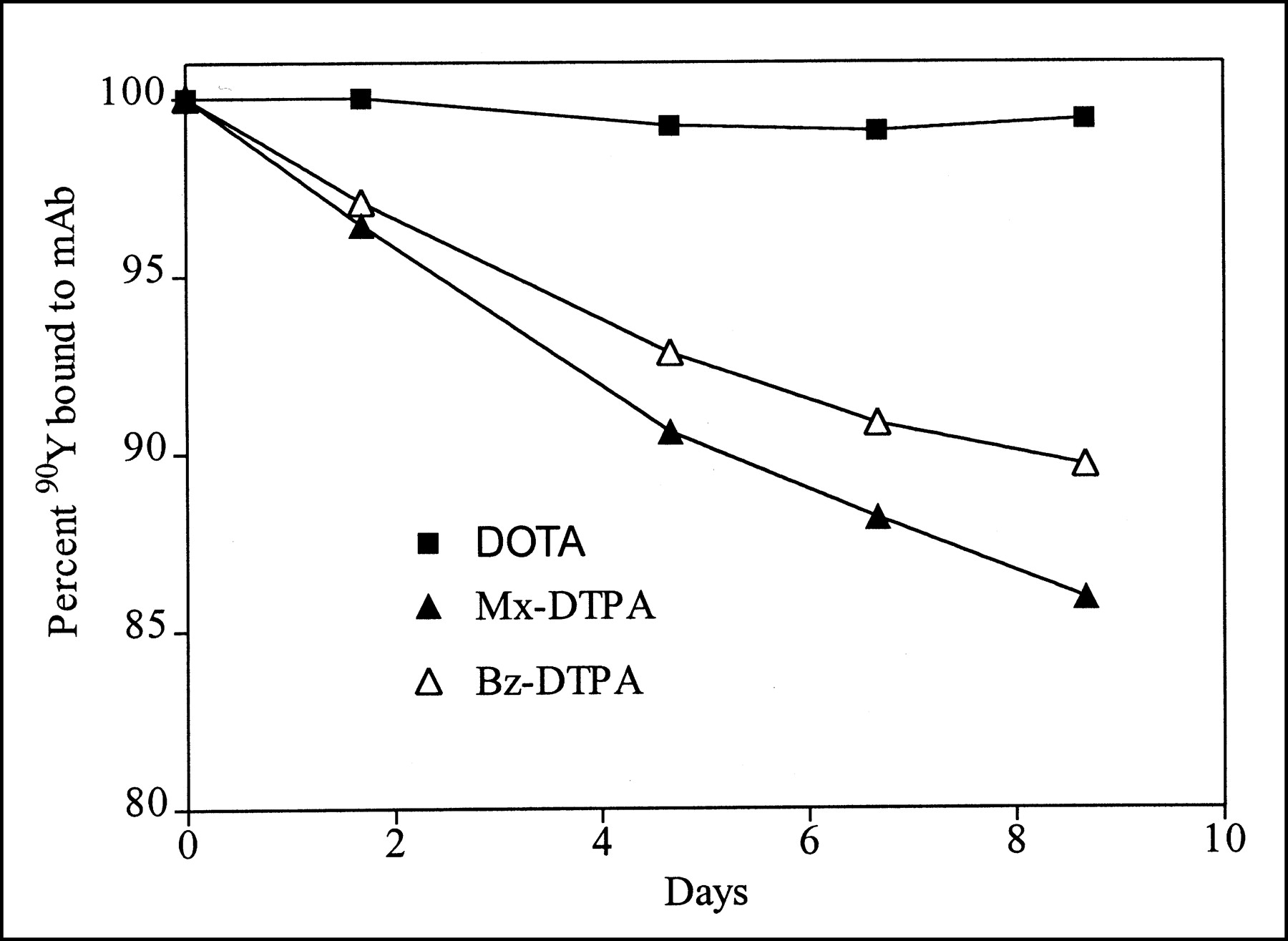
Comparative in vitro stabilities of 90Y-DOTA-, 90Y-Mx-DTPA-, and 90Y-Bz-DTPA-hLL2 conjugates in presence of excess of free DTPA chelate in 1% HSA over nearly 9 d at 37°C. Compressed y-axis covers range only from 80% to 100% of initially bound 90Y remaining bound to hLL2 mAb.
The in vitro stability data for the 90Y-DOTA-hLL2, 90Y-Bz-DTPA-hLL2, and 90Y-Mx-DTPA-hLL2 conjugates, when tested in normal human serum, are shown in Figure 3. A similar pattern emerges, with the 90Y-DOTA-hLL2 essentially inert to the serum challenge whereas the 90Y-Bz-DTPA-hLL2 and 90Y-MxDTPA-hLL2 conjugates progressively shed 90Y over time. Again, for each DTPA chelate about 4% of the initially bound activity is lost over the first 40 h, and between 6% and 9% of initially bound radioactivity is lost between 5 and 10 d after the initial incubation. Similarly to the DTPA challenge, the data showed little difference in 90Y stability between either variation of the 2 DTPA conjugates of the hLL2 mAb.
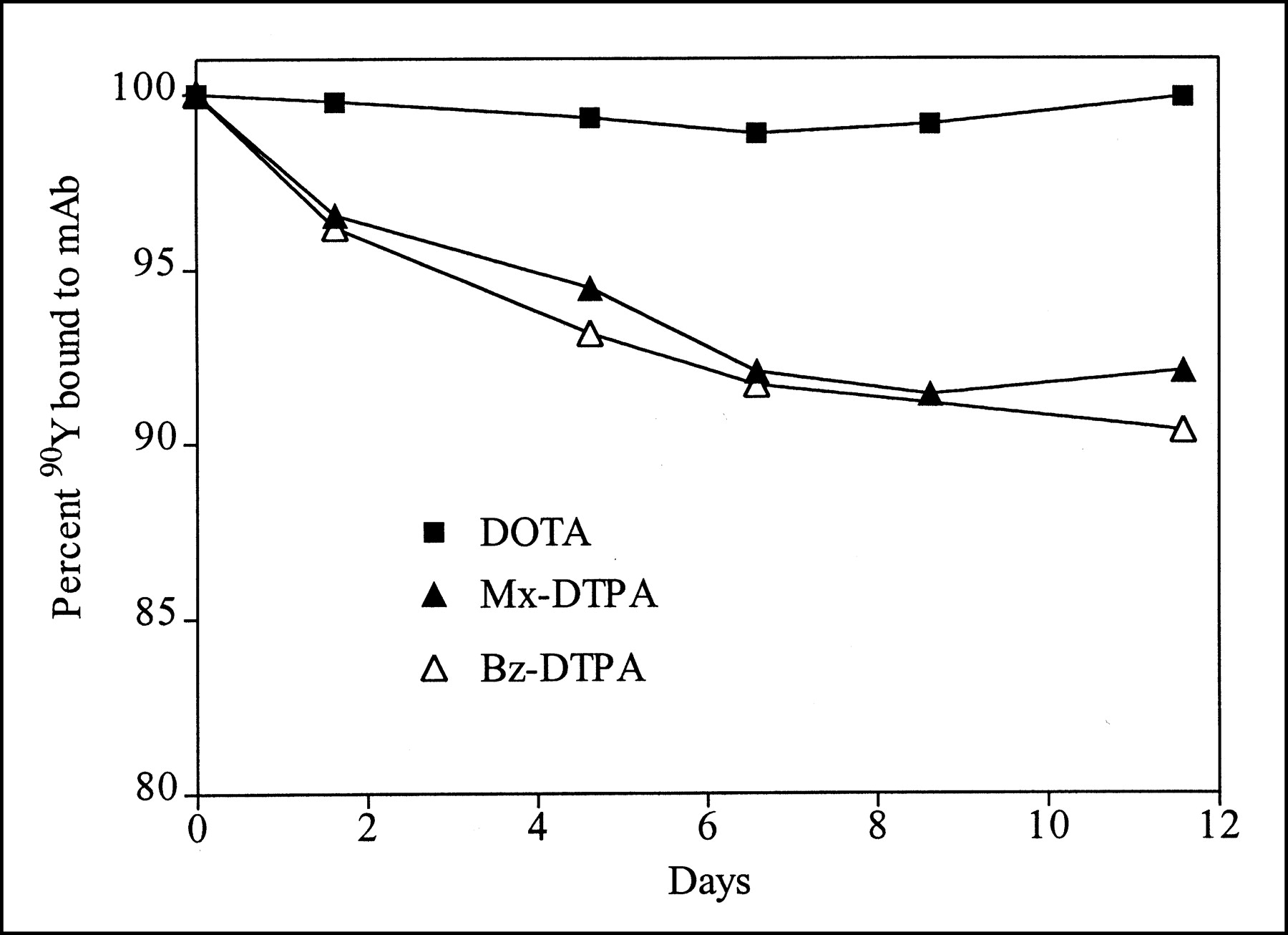
Comparative in vitro stabilities of 100 nmol/L amounts of 90Y-DOTA-, 90Y-Mx-DTPA-, and 90Y-Bz-DTPA-hLL2 conjugates in normal human serum over nearly 12 d at 37°C. Compressed y-axis covers range only from 80% to 100% of initially bound 90Y remaining bound to hLL2 mAb.
Figure 4 shows the comparative data for 88Y-DOTA-hLL2 and 88Y-Bz-DTPA-hLL2 in nude mice bearing Ramos lymphoma. Although both agents perform well in this animal xenograft model, with tumor xenograft uptakes and blood clearance rates being similar, it is evident that uptake in bone for 88Y-DOTA-hLL2 is lower than that for 88Y-Bz-DTPA-hLL2. The bone uptake difference is highlighted in the bottom trace, with bone and washed bone uptakes initially being similar at 24 h but uptake increasing for 88Y-Bz-DTPA-hLL2 and decreasing for 88Y-DOTA-hLL2 over the 10 d of the experiment. In a separate in vivo experiment, 88Y-DOTA-hLL2 was compared with 88Y-Mx-DTPA-hLL2, a conjugate prepared using a later-generation DTPA-type chelate (Fig. 1, R = methyl). This experiment was performed on normal mice to remove the possibility that variable tumor uptake might confound the primary data of interest related to bone uptake. Use of 88Y-Mx-DTPA-hLL2, compared with use of 88Y-DOTA-hLL2 (Table 1), resulted in much higher bone and washed-bone yttrium uptake in the mice from 72 h after injection of the reagents, with 2- to 4-fold less radiolabeled yttrium in these tissues when the macrocyclic chelate was used.
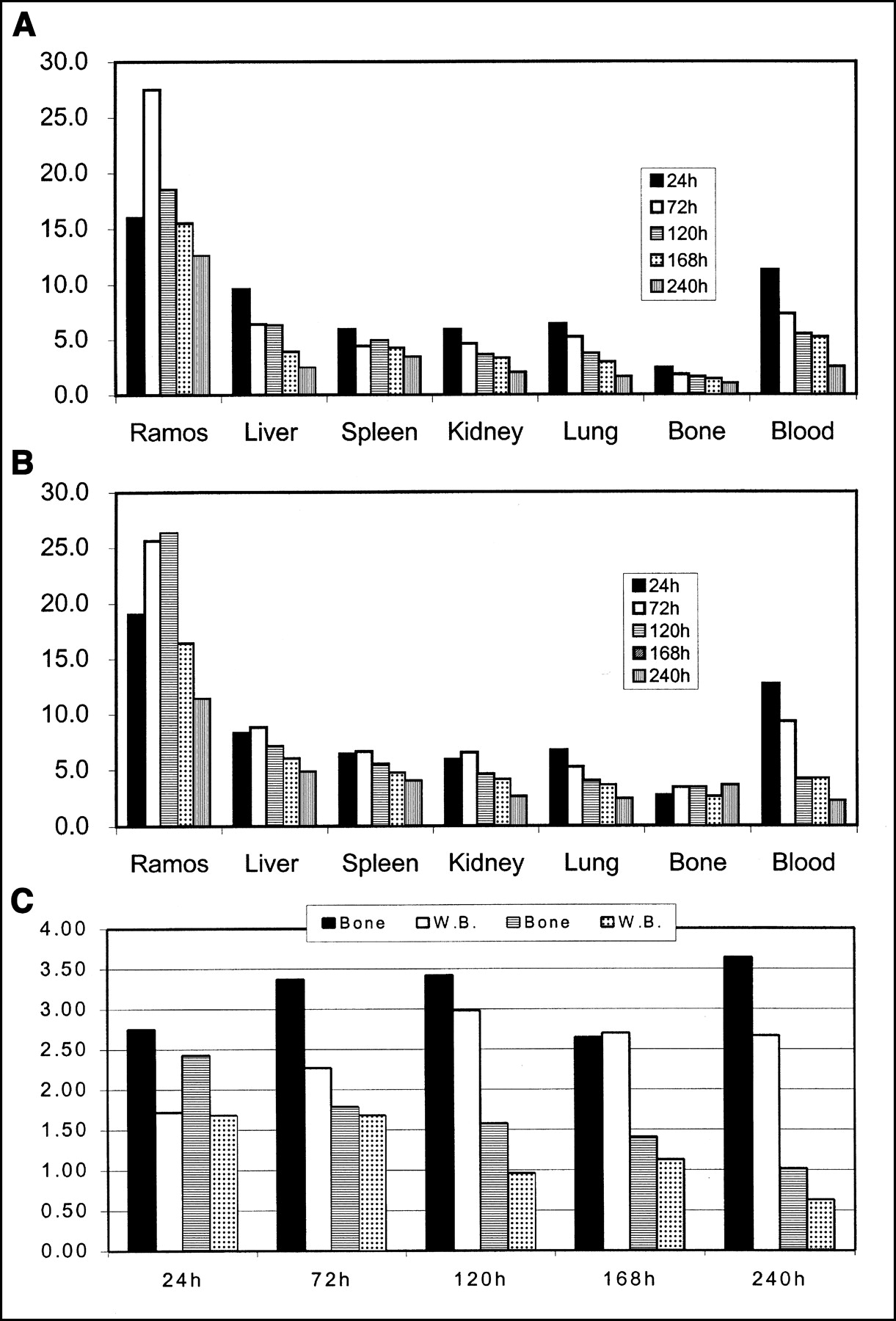
Biodistribution of 88Y-DOTA-hLL2 (A) and 88Y-Bz-DTPA-hLL2 (B), in nude mice bearing Ramos tumors, until 240 h after injection. (C) Uptake of 88Y-Bz-DTPA-hLL2 in bone (first column) and washed bone (second column) versus uptake of 88Y-DOTA-hLL2 over same period in bone (third column) and washed bone (fourth column). Data are in terms of %ID/g of tissue. W.B. = washed bone.
Comparative Biodistributions of 88Y-DOTA-hLL2 and 88Y-Mx-DTPA-hLL2 for All Major Organs in Normal Female BALB/c Mice Until 10 Days After Injection of Conjugates
Statistically (2-tailed test), bone uptake (P = 0.0218), but not washed-bone uptake (P = 0.3867), differed significantly between the DOTA and Mx-DTPA groups of animals as soon as 24 h after injection. Yttrium uptake differences for both bone (P = 0.0002) and washed bone (P = 0.0005) became highly significant by 72 h after injection, and these differences remained throughout the 240 h of the experiment for both tissues (P ≤ 0.001).
Dosimetric calculations were performed using the dataset in Table 1, and these calculations are reported in Table 2. Radiation absorbed doses (cGy/37 MBq administered) were broadly similar in most tissues for either chelate conjugate, although both liver and lungs received higher doses, 8,098 versus 6,988 cGy and 8,454 versus 7,175 cGy, respectively, from the 90Y-Mx-DTPA-hLL2 conjugate than from the 90Y-DOTA-hLL2 conjugate. Of most significance were the cGy/37 MBq absorbed doses for bone, rising from 3,555 for 90Y-DOTA-hLL2 to 5,405 for 90Y-Mx-DTPA-hLL2, and for washed bone, rising from 2,664 for 90Y-DOTA-hLL2 to 4,524 for 90Y-Mx-DTPA-hLL2. These findings indicate 52.0% and 69.8% higher absorbed doses to bone and washed bone, respectively, when the yttrium chelating agent was changed from macrocyclic to open chain.
Dosimetry Calculations for Dataset in Table 1
DISCUSSION
Several groups have examined the relative stabilities of cyclic and acyclic chelating agents used for yttrium, including various DOTA and DTPA analogs, respectively. Harrison et al. (20) described the dramatic superiority of 90Y-mAb conjugates made using backbone-substituted DOTAs and DTPAs over the earlier-generation mAb conjugates made with cyclic anhydride DTPA. They also noted the smaller apparent superiority (∼0%–30% lower bone uptake over the first 120 h after injection, with an increasing difference in favor of DOTA conjugates over the next 80 h) when using the same 90Y-mAb prepared with backbone-substituted DOTA versus backbone-substituted DTPA. In their work, the backbone substituents used as the mAb conjugation site were maleimidoalkyl groups alpha to a DOTA nitrogen or alpha to an N-terminal iminodiacetate subunit of the DTPA. More intensively investigated series of backbone-substituted derivatives have used para-benzyl derivatives attached in the same relative positions as the maleimidoalkyl groups reported by Harrison et al. Thus, 2-benzyl-DTPA derivatives (e.g., Bz-DTPA, Mx-DTPA, and cyclohexyl [CHX]-DTPA) and 2-acetamidobenzyl-DOTA derivatives (e.g., 2-IT-BAD, where IT is iminothiolane and BAD is 2-[p-(bromoacetamido)-benzyl]-DOTA) have been independently prepared and more lately compared for yttrium-binding properties. Both series require complex multistep organic syntheses to generate bifunctional chelates for mAb conjugation. The availability of appropriate starting materials together with the practical ability to follow reaction intermediates during synthetic processing probably account for much of the popularity of benzyl-substituted derivatives.
Camera et al. (28) compared biodistribution data for 88Y-labeled B3 mAb when yttrium was conjugated through an Mx-DTPA or a 2-Bz-DOTA chelate. They found larger differences in bone uptake of radiolabeled yttrium than those reported previously by Harrison et al. (20), with approximately 0.5- to 5-fold more yttrium in the bones of animals receiving the Mx-DTPA-mAb conjugates, and with these differences increasing consistently between 24 and 168 h after injection of the agents. From these data, an area-under-the-curve calculation for the femurs of the animals indicated values (percentage injected dose [%ID] × h/g) of 391 and 289 for the Mx-DTPA and the 2-Bz-DOTA conjugates, respectively, or a 35% increase in area under the curve (and, by implication, radiation dose) if one were substituting a 2-Bz-DOTA chelate for an Mx-DTPA chelate. DeNardo et al. (29) compared 90Y-Mx-DTPA- and 90Y-BAD-DOTA-BrE-3 mAb, but did so in terms of comparative toxicity, giving groups of mice increasing doses of mAb labeled with 90Y and using each chelate to determine maximum tolerated dose differences. For the 90Y-Mx-DTPA-mAb conjugate they found a median lethal dose of 8.2 MBq, whereas for the 90Y-BAD-DOTA-mAb a median lethal dose of 11.4 MBq was determined, meaning that 39% more 90Y could be tolerated when the BAD-DOTA chelate was used in lieu of an Mx-DTPA chelate.
Our data suggest an even larger difference between the 2 chelation methods, from 52% to almost 70% higher bone absorbed doses resulting from bone-deposited 90Y with the Mx-DTPA conjugate instead of the corresponding DOTA conjugate. These dose estimates were derived using appropriate correction factors for tissue self-absorbed doses and tissue crossover doses. The nearly 70% increase in 90Y uptake with regard to cortical bone might be of particular importance because, as DeNardo et al. (29) cogently point out from their own work, differences in toxicity found in mice are likely to be magnified in humans because of the size difference and the negligible amount of marrow dose to be derived from whole-body 90Y in humans compared with mice, in which most of the bone dose actually comes from whole-body 90Y decay.
An additional important issue is that since 90Y is a pure β-emitter, regulatory authorities are likely to insist that it be traced with an alternate nuclide to ensure that normal tissues receive acceptable doses. The 2 nuclides most suitable are 86Y and 111In, the former being a positron emitter and the latter a γ-emitting nuclide. 86Y produces high-energy emissions, is short lived at 14.7 h, and is difficult to produce and obtain on a widespread basis, whereas 111In is readily available. 86Y would be expected to predict 90Y-mAb biodistribution accurately when either a DOTA- or an Mx-DTPA-type chelate is used. Further, the easily obtainable 111In nuclide is not fully accurate in predicting 90Y-mAb conjugate distribution when open-chain DTPA-type chelates are used for preparing conjugates, as has been shown in several studies using different DTPA-type chelates and different mAbs (30,31). Of particular note are the patient studies by Pai-Scherf et al. (32), using an Mx-DTPA chelate-mAb conjugate. They took bone marrow biopsies for quantitation of both 111In and 90Y uptake and reported 0.0038 %ID/g and 0.0046 %ID/g, respectively, for each nuclide. However, the site of highest excess uptake of 90Y over 111In, as shown by the preclinical data presented in the current article, is in cortical bone rather than in bone marrow, and the differences reported by Pai-Scherf might not be fully descriptive of the absolute dose underestimation to be expected from using 111In as a 90Y-surrogate with Mx-DTPA chelate-mAb conjugates.
For Mx-DTPA-mAbs, these considerations present one with a dilemma as to whether to rely on 86Y for true accuracy in predicting 90Y-mAb biodistribution or to use 111In knowing that inaccurate estimations could result. It is clear from this work, and from previous work (21), that the carboxyl-linked form of DOTA-hLL2 can bind 111In and 90Y (or 88Y) with equal strength and a maximum resistance to in vivo challenges, as demonstrated by equivalent and low bone uptake of indium/yttrium nuclides. Such findings should allow future use of either 86Y or 111In, through PET or SPECT, respectively, for dose estimations with an expectation of equivalent accuracy, in a similar manner to backbone-substituted DOTA analogs (33). The in vivo performance results of our study with DOTA-hLL2 are in every sense equivalent to the best data seen with 2-IT-BAD-mAb conjugates, with the added practical advantage that the carboxyl-linked DOTA-hLL2 used here is produced without the need for a complicated synthesis of a backbone-substituted DOTA.
It would be interesting to directly compare backbone-substituted and carboxyl-substituted DOTA-mAb conjugates on the same antibody, since these 2 groups of DOTA-mAb conjugates have both been proven to be completely stable to 90Y dissociation in vivo. Backbone-substituted DOTA-mAbs that have been tested in patients have recently been reported to display rather high liver uptake (34), and it remains to be seen whether carboxyl-substituted DOTA-mAbs will show that same property and to the same extent. One might then speculate on how additional improvements might be made to 90Y radioimmunotherapy. Future attempts to further mitigate the absolute uptake of 90Y in bone after administration of 90Y-Bz- (or Mx- or CHX-) mAb conjugates are likely to involve concomitant or early administration of an excess of free chelate, such as EDTA or DTPA (35), but such an approach would likely not be useful given the high-stability profiles of the 90Y-DOTA conjugates. One approach for DOTA-mAb conjugates is to vary the chemical linkage between chelate and mAb, and studies on backbone-substituted DOTA-mAb conjugates prepared with cleavable linkers spaced between the 2-IT-BAD and the mAb to which it is attached have been reported (36,37). However, a more substantive improvement in achievable efficacy will probably require the adoption of some sort of pretargeting protocol (38–40).
CONCLUSION
The DOTA-hLL2 conjugate that we have described is easy to prepare and to radiolabel with 90Y at high stability. When the DOTA chelate is used to attach 90Y to hLL2, the radioimmunoconjugate shows a significantly improved stability profile compared with that of 90Y-hLL2 conjugates prepared with bifunctional DTPA-type chelates. This improvement not only will ensure optimal 90Y-conjugate tissue localization and clearance properties but also should minimize toxicity while providing confidence about the accurate prediction of 90Y doses from imaging studies using 111In- or 86Y-radiolabeled hLL2.
Footnotes
Received Mar. 7, 2002; revision accepted Aug. 21, 2002.
For correspondence or reprints contact: Gary L. Griffiths, PhD, Immunomedics, Inc., 300 American Rd., Morris Plains, NJ 07950.
E-mail: ggriffiths{at}immunomedics.com
REFERENCES
In this issue



Jump to section
Related Articles
Cited By...
- Preclinical Characterization of the Radioimmunoconjugate 111In or 90Y-FF-21101 Against a P-Cadherin-Expressing Tumor in a Mouse Xenograft Model and a Nonhuman Primate
- Anti-CD22 90Y-epratuzumab tetraxetan combined with anti-CD20 veltuzumab: a phase I study in patients with relapsed/refractory, aggressive non-Hodgkin lymphoma
- Treatment of Advanced Pancreatic Carcinoma with 90Y-Clivatuzumab Tetraxetan: A Phase I Single-Dose Escalation Trial
- Combination Radioimmunotherapy and Chemoimmunotherapy Involving Different or the Same Targets Improves Therapy of Human Pancreatic Carcinoma Xenograft Models
- High Rates of Durable Responses With Anti-CD22 Fractionated Radioimmunotherapy: Results of a Multicenter, Phase I/II Study in Non-Hodgkin's Lymphoma
- Pretargeted Versus Directly Targeted Radioimmunotherapy Combined with Anti-CD20 Antibody Consolidation Therapy of Non-Hodgkin Lymphoma
- Therapy of Advanced B-Lymphoma Xenografts with a Combination of 90Y-anti-CD22 IgG (Epratuzumab) and Unlabeled Anti-CD20 IgG (Veltuzumab)
- Evaluation of response to fractionated radioimmunotherapy with 90Y-epratuzumab in non-Hodgkin's lymphoma by 18F-fluorodeoxyglucose positron emission tomography
- Therapeutic Advantage of Pretargeted Radioimmunotherapy Using a Recombinant Bispecific Antibody in a Human Colon Cancer Xenograft
- 89Zr as a PET Surrogate Radioisotope for Scouting Biodistribution of the Therapeutic Radiometals 90Y and 177Lu in Tumor-Bearing Nude Mice After Coupling to the Internalizing Antibody Cetuximab
- Radioimmunotherapy of CD22-Expressing Daudi Tumors in Nude Mice with a 90Y-Labeled Anti-CD22 Monoclonal Antibody
- Dose-Fractionated Radioimmunotherapy in Non-Hodgkin's Lymphoma Using DOTA-Conjugated, 90Y-Radiolabeled, Humanized Anti-CD22 Monoclonal Antibody, Epratuzumab
- A Phase I Trial Combining High-Dose 90Y-Labeled Humanized Anti-CEA Monoclonal Antibody with Doxorubicin and Peripheral Blood Stem Cell Rescue in Advanced Medullary Thyroid Cancer
- Epratuzumab, a Humanized Anti-CD22 Antibody, in Aggressive Non-Hodgkin's Lymphoma: Phase I/II Clinical Trial Results
- Characterization of a New Humanized Anti-CD20 Monoclonal Antibody, IMMU-106, and Its Use in Combination with the Humanized Anti-CD22 Antibody, Epratuzumab, for the Therapy of Non-Hodgkin's Lymphoma
- Radioimmunotherapy of Non-Hodgkin's Lymphoma with 90Y-DOTA Humanized Anti-CD22 IgG (90Y-Epratuzumab): Do Tumor Targeting and Dosimetry Predict Therapeutic Response?
- Low-Dose Radioimmunotherapy (90Y-PAM4) Combined with Gemcitabine for the Treatment of Experimental Pancreatic Cancer