Abstract
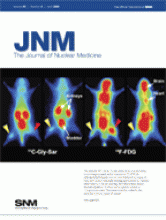
H+/peptide transporter, PEPT1, is functionally expressed in some human cancer cell lines and might be a candidate molecular target for detection of cancers in vivo using PET. The aim of the present study was to establish a novel tumor-imaging technology using a PET tracer targeted to H+/peptide transporter(s). We also compared the tracer with 18F-FDG, focusing on the specificity of their accumulation between tumor and inflammatory tissues. Methods: A dipeptide PET tracer, 11C-glycylsarcosine (11C-Gly-Sar), was injected intravenously into athymic mice transplanted with human pancreatic, prostate, and gastric cancer cells. The distribution patterns of 11C-Gly-Sar and 18F-FDG in the tumor-bearing mice, and in mice with inflammatory tissue, were assessed by imaging with a positron planar imaging system (PPIS). Tissue distributions of tracer radioactivity were also measured. The expression levels of PEPT1 and PEPT2 (PEPTs) proteins in tumor xenografts and inflammatory tissue were examined by immunohistochemical analysis. The messenger RNA expression levels of PEPTs in 58 available cancer cell lines were quantified by means of real-time polymerase chain reaction. Results: All 3 tumor xenografts were well visualized with the PPIS after injection of 11C-Gly-Sar. Expression of PEPTs in those xenografts was confirmed by immunohistochemical analysis. Tumor-to-blood concentration ratios of 11C-Gly-Sar increased in a time-dependent manner and were much higher than unity. Most of the radioactivity found in the tumor tissue was recovered as the intact tracer. These results indicated that 11C-Gly-Sar was taken up by the PEPTs in tumor xenografts. It is noteworthy that 11C-Gly-Sar was minimally present in inflammatory tissues that expressed no PEPT1 or PEPT2 protein, whereas 18F-FDG was highly accumulated, with the values of the selectivity index being >25.1 and 0.72 for 11C-Gly-Sar and 18F-FDG, respectively. The mRNAs of PEPT1 and PEPT2 were expressed in 27.6% and 93.1%, respectively, of the cancer cell lines examined in the present study. Conclusion: The present study indicates that 11C-Gly-Sar is a promising tumor-imaging agent and is superior to 18F-FDG for distinguishing between tumors and inflammatory tissue. Because PEPTs were ubiquitously expressed in various types of tumor cells examined, 11C-Gly-Sar could be useful for the detection of many types of cancers.
- H+/peptide transporter
- PEPT1
- PEPT2
- peptide transport activity
- dipeptide PET tracer
- 11C-glycylsarcosine
- cancer detection
Footnotes
-
COPYRIGHT © 2008 by the Society of Nuclear Medicine, Inc.