JNM
HOME HELP FEEDBACK SUBSCRIPTIONS ARCHIVE SEARCH TABLE OF CONTENTS
 QUICK SEARCH:   [advanced]


First published online November 7, 2008, 10.2967/jnumed.108.052688
This Article
Right arrow Figures Only
Right arrow Full Text
Right arrow Full Text (PDF)
Right arrow All Versions of this Article:
jnumed.108.052688v1
49/12/1999    most recent
Right arrow Alert me when this article is cited
Right arrow Alert me if a correction is posted
Services
Right arrow Email this article to a friend
Right arrow Related articles in JNM
Right arrow Similar articles in this journal
Right arrow Similar articles in PubMed
Right arrow Alert me to new issues of the journal
Right arrow Download to citation manager
Right arrow reprints & permissions
Citing Articles
Right arrow Citing Articles via Google Scholar
Google Scholar
Right arrow Articles by Georgiou, M. F.
Right arrow Articles by Kumar, M.
Right arrow Search for Related Content
PubMed
Right arrow PubMed Citation
Right arrow Articles by Georgiou, M. F.
Right arrow Articles by Kumar, M.
Journal of Nuclear Medicine Vol. 49 No. 12 1999-2005
© 2008 by Society of Nuclear Medicine

doi: 10.2967/jnumed.108.052688

Clinical Investigation

Analysis of the Effects of Injecting Drug Use and HIV-1 Infection on 18F-FDG PET Brain Metabolism

Michalis F. Georgiou1, Ati Gonenc1, Drenna Waldrop-Valverde2, Russ A. Kuker1, Shabbir H. Ezuddin1, George N. Sfakianakis1 and Mahendra Kumar2

1 Department of Radiology, University of Miami School of Medicine, Miami, Florida; and 2 Department of Psychiatry and Behavioral Sciences, University of Miami School of Medicine, Miami, Florida

Correspondence: For correspondence or reprints contact: Michalis F. Georgiou, Nuclear Medicine (D-57), P.O. Box 016960, Miami, FL 33101. E-mail: mgeorgio{at}med.miami.edu

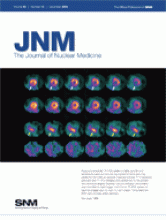
Injecting drug use (IDU) is a major risk factor for contracting HIV-1 infection. Both HIV and IDU are neurotoxic, and their coexistence may lead to increased dysfunction of brain metabolic processes. The objective of this research was to investigate the effects of HIV-1 infection and IDU on 18F-FDG PET brain metabolism. Methods: 18F-FDG PET brain imaging, with a standard clinical protocol, was performed on 59 subjects who belonged to 3 groups: HIV-positive/IDU-positive (n = 17), HIV-negative/IDU-positive (n = 13), and HIV-negative/IDU-negative controls (n = 29). A voxel-based analysis of the 18F-FDG PET brain images was performed using statistical parametric mapping. The images were spatially normalized to a standard 18F-FDG template, proportionally scaled to compensate for count differences, and then appropriately smoothed. Statistical 2-sample t tests were performed to determine regional metabolic distribution differences in the 3 groups. Results: Diffuse hypermetabolism in the subcortical and deep white matter, the basal ganglia, and the thalami was observed in HIV-1 infection. IDU resulted in increased brainstem metabolism and decreased activity in cortical structures including bilateral medial frontal lobes and the right inferior frontal and temporal cortices. The cortical hypometabolism was more extensive in HIV-1–infected subjects, involving the left temporoparietal and right parietal cortices and bilateral medial frontal lobes. Conclusion: Voxel-based analysis of 18F-FDG PET brain images demonstrated statistically significant differences in regional metabolism for the 3 studied groups. It also showed that HIV-1 infection may have a synergistic effect with IDU, resulting in more extensive cortical hypometabolism. Correlation of these findings with other quantitative approaches and neurocognitive functioning is warranted.

Key Words: 18F-FDG PET brain imaging • injecting drug use • HIV-1 infection • statistical parametric mapping

COPYRIGHT © 2008 by the Society of Nuclear Medicine, Inc.

Related articles in JNM:

This Month in JNM

JNM 2008 49: 11A-12A. [Full Text]  


HOME HELP FEEDBACK SUBSCRIPTIONS ARCHIVE SEARCH TABLE OF CONTENTS
JOURNAL OF NUCLEAR MEDICINE TECHNOLOGY THE JOURNAL OF NUCLEAR MEDICINE
Copyright © 2008 by the Society of Nuclear Medicine.